Uncle Antoine

“On the shore of Little Rock Lake lived several families of French-Indian breeds. The had a few scrub ponies, cows and pigs.  The lived in log huts and farmed small tracts.  They hunted, fished, trapped and did nothing.   One breed was named Steve Baillou and another Antoine Blais, which became pronounced Steve Blue and Tony Blair by the neighbors.” – from notes of Nelson and Robert Flint, included in A Land Called Morrison, by Harold Fisher

Antoine Blair, one of the younger brothers of Angeline (Blair) Trotterchaud, had been living in the area since at least 1849.  The territorial census of that year listed him at 21 years of age and living in the “Sauk Rapids District” of “Benton Territory.” (Apparently, Benton County was not officially a county yet.)  Also counted in Antoine’s household were Charlotte, age 16 and Josette, age 4 months. Antoine’s occupation was listed as “none”.

In 1849, year Minnesota became a territory, less than 6000 non-Indians lived here, and only a few hundred lived north of St. Paul. Reading the census data, it appears that the nearest white people in the area were the missionaries Frederick and Elizabeth Ayer, who had established a mission and farm at Belle Prairie, some 20 miles up the Mississippi, in 1848. (Belle Prairie is the area where the Bellefuielle family first settled in the 1850s.)

In that same year an American Fur Company employee named David Gilman moved to the area and purchased a trading post established the previous year by Asa White. Another trading post was established by William Aitken just two miles north.  The place was called Watab, and was located near the mouth of a river by that name that emptied into the Mississippi.  Antoine may have been employed by Aitken or Gilman or at least traded with them.  Trading was done with a large Ojibwe village located near the outlet of Little Rock Lake. From 1848 to 1855, trade was also conducted with the Winnebago tribe, whose members were relocated to the area from Iowa for that brief period in a move orchestrated by businessman and trader Edmund Rice. This scheme was intended to open lands for settlement in Iowa while establishing the Winnebago as a buffer between the Ojibwe and their Dakota (Sioux) enemies.

Watab was also located along the Red River Oxcart Trail as it followed the Mississippi south to St. Paul.  The oxcart trail system was developed by Norman Kittson a few years before to facilitate trade between St. Paul and settlements on the Red River north of Pembina. The mostly Metis oxcart drivers, who were independent contractors, tended to carry cash, which drew the interest of the traders and other merchants who started settling the area.

In 1857,  according to General Land Office records Antoine obtained the deed to some 37 acres located along the west shore of Little Rock Lake, near present-day Rice, Minnesota. The Preemption Act of 1841 permitted “squatters” who were living on federal government owned land to purchase up to 160 acres at a very low price (not less than $1.25 per acre) before the land was to be offered for sale to the general public. To qualify under the law, the “squatter” had to be:

a “head of household”;
a single man over 21, or a widow;
a citizen of the United States (or an immigrant intending to become naturalized); and
a resident of the claimed land for a minimum of 14 months (Wikipedia).

The 1860 census recorded Antoine’s occupation as “Farmer”, which was typically used for homesteaders. However, the 1870 census lists him as a “Livestock Raiser”.  This suggests that Antoine, as well as one of his younger brothers listed the same way in the census, developed a business raising and selling draft animals.  These likely included oxen that were sold to the drivers on the oxcart trail.

The 1860 census indicates Antoine had five children, ranging from 2 to 9 years old, including Josette.  However, Charlotte is not listed. Another woman named “Gebel”, age 30 is listed. The name is a misspelling of Isabelle. According to Ancestry.com, her Indian name was Quanzee. It appears that Charlotte had passed away sometime in the previous 11 years.

Antoine and “Belle” raised their family at Little Rock Lake and apparently prospered there. I had the opportunity while doing research at the Benton County Historical Society to review papers associated with the disposition of Antoine’s property and settlement of his debts. David Gilman served as the executor until his death in 1885. The process was finalized by a man named Campbell. The file included dozens of slips of paper with transactions recorded in pencil. Antoine appeared to have good credit, as he did business throughout the area from Little Falls to Elk River.

My hunch is his success played a role in convincing Peter and Angeline Trotterchaud to move their young family there.  Peter purchased his land claim consisting of 39 acres next door to Antoine’s homestead in 1856.  (More to follow on the Trotterchauds in later posts) When Peter and Angeline and several of the Blairs moved to White Earth under the terms of the 1867 Treaty, Antoine and his family stayed behind.  Apparently, he was doing well enough that the prospect of receiving 160 acres of land and a fresh start did not appeal to him.

Antoine died in 1883 when he was crushed by an ox. According to his death certificate, the cause of death was falling off a wagon.  But according to Mary Ostby, Executive Director of the Benton County Historical Society, it was common to avoid blaming an ox for the death, as it would make the animal difficult to sell. Antoine’s death was noticed in the Sauk Rapids Sentinel, which noted “Tony” was well known in the area.  Even though he was a “French breed” who “did nothing,” he had earned at least some respect in his community.
Our Mysterious New Neighbors

Below our homesite, the lake is quite shallow (2 to 3 ft deep) and full of lily pads, which essentially precludes docking a boat or pontoon. That is fine with Mel and me; we would like to keep the shoreline undeveloped. However, I thought it would be nice to have a footpath from the house down to the shoreline. All this path required was moving a deadfall or two and trimming a few low-hanging branches.

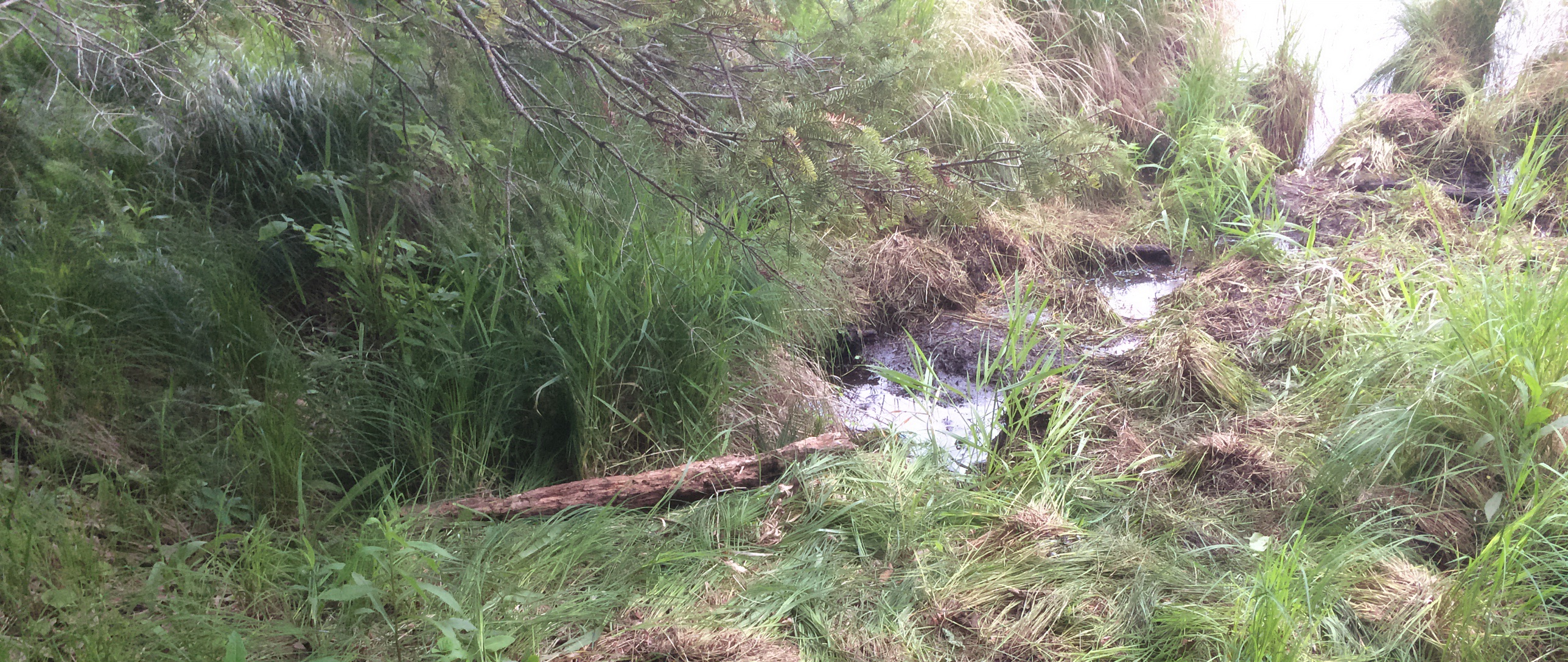
One day in June, while working on this project, I came across a strange scene. In an area about the size of a dining room table adjacent to the waterline, all the grass had been flattened. My first thought was that a bear had been lounging around, maybe gnawing on a dead fish. As I looked closer I found scat, but it didn’t look like something that came out of the backside of a bear. The stools were smaller than standard bear poop and were full of bits of shell and fish scales.image

image

Ok, maybe not a bear, but a racoon, I thought. But why would racoons flatten all this grass? As I pondered this I glanced up the slope and noticed more grass flattened and what looked like an anthill that had been leveled. Again, it could have been a bear searching for some 6-legged appetizers. But there were no claw marks indicating digging.  Instead, the dirt looked smoothed out, like something had been sliding on it. That’s when I got excited – this could be river otter sign.

image

Otters are my favorite animal. If I had to choose an animal form for the next life, it would be the otter. My kids know I have a thing for otters; Emily even sculpted one out of soapstone for me.

The first time I saw otters in the wild I was deer hunting with my dad, about 20 years ago. I was standing on the edge of a clear cut, waiting for Dad to work his way across. The sun had set, so it was nearing the end of the hunting day. While watching Dad pick his way across the stumps and brush, I heard splashing behind me. There, in a pond about 75 yards away, were two otters playing. They were silhouetted in the orange dusk. Dad and I watched them for several minutes until it finally grew too dark to see them and then we headed back to camp. This is a favorite memory for me.

We have seen muskrats and beavers swimming along our shoreline, and even had a tree cut down in our yard by a beaver, but we had never seen otters. How cool would it be to have otters living next door? Having a bear in the neighborhood would be less cool.  If they are otters, we would be lucky to actually see them. Although they are playful and seem gregarious, they are quite shy.

Maybe one of my thoughtful children will get me one of those trail cameras for Christmas…

On the Farm, Part 1

Grandpa owned a small grain farm in partnership with his ‘Pa’, Great-grandpa Alfred. The farm, just 160 acres, consisted of several hillocks with wetlands winding between them. It was located about a half-mile west of Westbury where my mom grew up and about 4 miles north of Grandpa and Grandma’s place on Cozy Cove Road. The soil at the farm was rocky and pretty thin on the hilltops. The farm never made much money, but it provided an income for Great-grandpa and Great-grandma Almie to supplement Social Security. Looking back now, I don’t think Grandpa Ray wanted to be farming, but kept the operation going for the sake of his parents. Farming was all they knew, and the old farmhouse was their home.

I started working on the farm when I was about 10, mostly picking rock, running for tools or parts, and helping feed Great-grandpa’s hogs. Grandpa Ray taught me how to do basic maintenance on the equipment, like greasing the myriad pulleys on the combine, replacing shear pins on the cultivator and pumping up tires. As I grew older, I learned how to operate the equipment.

I took a lot of pride in being able to hook up the plow or cultivator and head out to a field to work on my own. I usually drove Grandpa’s John Deere 720 Diesel, the biggest tractor on the place. We had another older John Deere, a Model ‘A’ that was Great-grandpa’s favorite. He taught me how to start it by turning the flywheel. Great-grandpa seemed to look younger and stronger when he sat on that tractor.

Grandpa Ray’s favorite seemed to be the Allis Chalmers WD with the narrow front. It was the one tractor he never taught me to drive. I was a little scared of it, remembering the story Grandpa told me about my uncle Tom breaking his arm trying to start it with the hand-crank in front.

The WD was Grandpa’s go-to tractor for particular jobs, like harrowing, seeding and raking hay. The latter chore was fascinating to watch. Grandpa would pull the rake in high gear at full throttle, creating windrows on the fly. The rake itself was an almost fanciful contraption, with large wheels full of tines mounted at an angle and spinning rapidly. The WD could turn on a dime, and Grandpa was expert at the maneuvers needed to create windrows of the proper spacing and volume for baling. Watching him rake a field of alfalfa on a late summer evening was like watching a ballet.

One of my favorite memories from the farm is how much I enjoyed Great-grandma Almie’s cooking.  By how much I mean I ate a lot of it!  We started out very early each morning with coffee and homemade cookies or banana bread and then went out and got the machinery ready to go. Then we came back in for breakfast, which was usually ham and eggs and coffee and pancakes and more coffee.  Sometimes we came back in for a coffee break mid-morning and ate more baked goodies. Lunch was another big meal, after which Grandpa Ray would take a nap.  After at least one more coffee break in the afternoon, we worked late and came in for supper, somehow hungry for more.  Great-grandma cooked for threshing crews when she was younger so she knew how to make good, rib-sticking food and lots of it.

I enjoyed working on the farm, except at harvest time. Grandpa planted at least half the acreage in barley every year. Unlike wheat, heads of barley have a heavy beard, which becomes a cloud of itchy chaff as it is combined. Early on, the farm had a combine that was pulled by a tractor. Later, Grandpa bought a self-propelled combine, which I considered to be the height of farming technology, even though it did not have an enclosed cab. I rode the combine with Grandpa until I was old enough to operate it myself.

Harvesting barley was the dirtiest and itchiest job in the world. Perched above the noisy “pickup”, a short, wide conveyor that pulled the windrows into the combine for threshing, the operator was smack in the middle of the dust cloud billowing up. To make matters worse, we always harvested during the dog days of August, with temperatures above 90 before noon. Sweat made the dirt and chaff stick to the skin. Like most boys entering puberty, I was probably reluctant to start showering. But nothing felt better than a hot shower after a day of riding the combine.

Another dirty job was shoveling grain into bins. The farm did not have any of the shiny grain bins the bigger farms had. Instead, we built make-shift bins in unused areas of the barn and in the old feed shed. Some grain was also stored on Grandpa’s place using old farm buildings the same way. The bins consisted of old boards nailed up to enclose doorways and form up sides. Because these were usually odd-shaped configurations and the roof was low, my job was to climb into the bin and shovel the grain into the corners and level it out as it came out of the auger. This meant trying to shovel while knee-deep or on my knees, breathing hot air full of dust in the mostly enclosed bin until the load was emptied or the bin was full. Grandpa always kept an eye on me in case the heat and dust got to be too much, but I hung in there until the job was done.

Harvest time seemed more fun when I was younger. I can remember riding to the grain elevator in Callaway with Great-grandpa in the “grain truck.” A ’42 Ford one-ton with a hydraulic lift and a wooden grain box, the truck seemed as ancient as Great-grandpa. And like Great-grandpa, the truck smelled of Copenhagen snuff. He always had a pinch in his cheek, and spat through the hole in the floor boards of the old truck. Other times I rode with Grandma, who drove the pickup with boards mounted on the sides of the box. If I was lucky, I got a bottle of pop while the elevator man dumped the load through the grated floor. I loved to watch Lyle, the manager, work the grain sorter that helped him calculate dockage for weed seed and debris. But we didn’t dawdle – we had to get back to the farm right away so Grandpa wouldn’t yell at us.

Grandpa wasn’t as much fun to be around on the farm compared to when we were out on the lake. Between the equipment breakdowns and bad weather, getting everything done was always stressful for him. He yelled a lot. He yelled at Grandma, he yelled at Great-grandpa, and he yelled at me. I did a lot of things wrong, and sometimes Grandpa would get upset, but for the most part he was patient with me. He wanted me to learn.

What usually got me in trouble was not paying attention. I was a daydreamer, staring off into space thinking about who knows what while Grandpa was yelling for a 5/8″ socket. More than once I incurred his wrath while sitting on the tractor in a reverie as he was frantically waving from the overfull combine for me to bring the gravity wagon. Sometimes I would forget to follow through on an assignment he gave me and then I would “catch hell.” Fortunately, Grandpa didn’t stay mad at me for long, and he would patiently put me back to work.

Recently, I asked Grandma Arleen why Grandpa didn’t seem to like farming. She told me a story about farming in earlier days.  The events in that story shaped our family’s future.  The story also gave me a better understanding of Grandpa.  I’ll share that story soon.

The Best Laid Plans….

Mel and I have long agreed that one of the “must haves” in our new house was a screen porch. We saw the porch as the best way to enjoy summer evenings in the woods: watching the sun set over the lake, listening to the loons and enjoying friends and family all without having to swat mosquitoes.

When we began designing the house our emphasis on a passive solar design required that the porch be located on the end of the house to maximize the number of south-facing windows. Having the porch on the southwest end made the most sense, since it was closest to the lake and would have the best view. We anticipated that we would be cutting into the ridge on the west side of the house to create a level surface for building. We thought this would mean the porch would have a 3- or 4-ft berm against it, but believed there would still be room for a view.

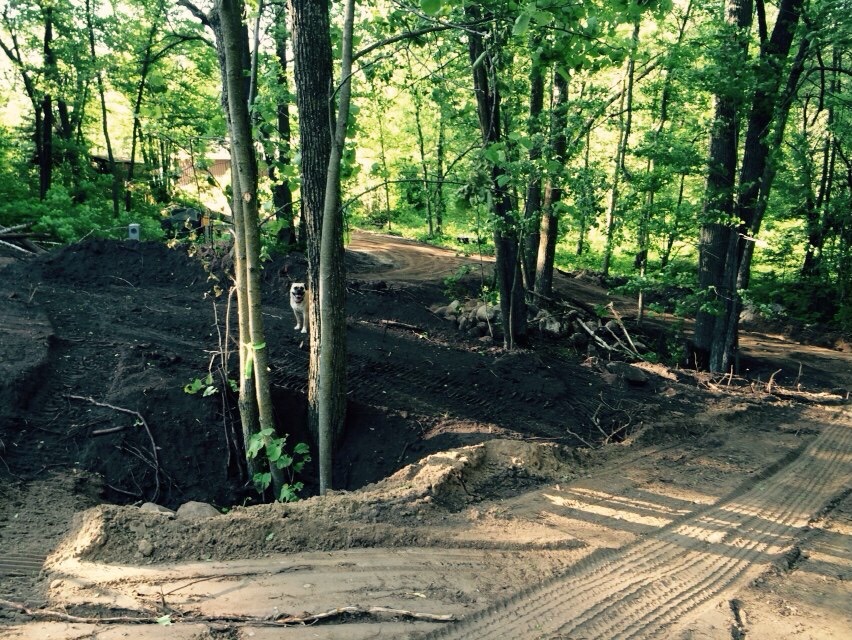
By the time excavation was completed and the foundation was in place, it was clear that we had underestimated the depth of the cut on the west end of the house. What we thought would be a 4-ft cut became a 7-ft cut. To get any kind of view out the porch would require excavating out the south toe of the ridge, which lies within the 100-ft shoreline buffer zone. After obtaining a variance, our excavation contractor had already taken some of this material out, which created a nice level space for a patio in front of the living and dining rooms. But to get the view we wanted from the porch would have required taking out a lot more material, doubling the size of the disturbance in the buffer zone.

image

The screen porch was to go in this corner. (Buddy included for scale)

Meanwhile, Mel was lamenting the size of her sewing room and spare bedroom. As an unintended result of making revisions to the plans previously, this room became less than 11 ft wide. This worked against our original intention of having a spacious, handicapped-accessible spare room. After contemplating these issues while staring at the ceiling one sleepless night, I came up with a solution to both problems. We would eliminate the screen porch, move the TV room (which doesn’t need a lot of windows) into that space and expand the sewing room and spare bedroom. We ran the idea by Bernie, our contractor, who had also been scratching his head about the porch. He thinks the change makes sense.

Giving up the screen porch is hard. We’ll have to put up with the bugs if we want to sit outside in the evenings. More than that, it means giving up a fun, comfortable space in which to entertain and relax. But the space would only have been used 3 or 4 months out of the year, which doesn’t sit well with our practical mindset. We’re at peace with this change; we get a little more space where we need it and we won’t have to break more ground. Someday maybe we’ll build a screen gazebo. Meanwhile, we’ll just use more bug spray.

Out of the Woods

Following their marriage at La Pointe in 1843, the next data point I found for Pierre and Angeline Trotochaud is July 27, 1848. On this day, Pierre declared his intention to become a U.S. citizen before a county clerk in St. Croix County, Wisconsin Territory. This would have been in Stillwater, in what is now Minnesota. Later that year Wisconsin became a state. The following year, 1849, Minnesota Territory was formed from the areas left over after Wisconsin and Iowa (1846) statehood.

I came across this information in a book titled “Declarations of Intention (1847-1852) of 262 Minnesota Pioneers”, published by the Minnesota Historical Society. The author, James E. Erickson stumbled upon an index of the first declarations made in St. Croix County and was able to track down the actual hand-written declarations for all but 3 of the 262 pioneers. Unfortunately, Pierre’s declaration, which would have stated where he entered the U.S., is one of the missing three.

Stillwater was ground zero for the beginning of Minnesota’s logging boom. One can imagine how shocking it must have been for the young couple to come from Sandy Lake (or LaPointe or Fond du Lac or Lac du Flambeau), deep in the woods, to this boomtown with all its hustle and bustle.

They may have come to Stillwater looking for work, or they may have just been passing through. Regardless, they were leaving behind the life they knew. The fur trade was winding down, transitioning from large monopolies like the American Fur Company controlling vast territory to independent traders focusing on particular locations still holding furs. Working for these independents probably was not as stable as working for the old “outfits”.

Meanwhile, their Ojibwe relatives were finding the subsistence lifestyle more difficult to maintain. A succession of treaties the Ojibwes were making with the federal government continued to reduce their land base, making them dependent on government food supplies.

These were the circumstances that set the stage for the Sandy Lake Tragedy in 1850. Territorial officials, led by Alexander Ramsey, sought to remove the Ojibwe from Wisconsin. To do so, they moved the location of the annuity payments under the treaty from LaPointe to Sandy Lake. Thousands of Ojibwe made the trek to Sandy Lake, only to find the annuity payment had been delayed. Government food supplies were late in coming, and what food was available was spoiled, which eventually sickened and killed hundreds. Lobbying by Ojibwe chiefs and public pressure finally forced the government to allow the people to return to their homelands. But by then winter had set in, and many more died on the way.

It is not clear whether any of Pierre and Angeline’s extended family were still at Sandy Lake to witness the tragedy. Her brother Antoine had settled on land near Little Rock Lake, near present-day Rice, Minnesota in 1849. It is possible that Margaret Blair (Ma Chay) and the younger siblings stayed at Sandy Lake, among her relatives. As for Pierre and Angeline, the 1849 census (and the 1850 census) found them in Little Canada.

Founded just 5 years before by Benjamin Gervais, Little Canada, as the name implies, was originally a town full of French Canadians. Gervais had arrived in the area as a refugee from the Red River colonies in 1826, and was twice forced off Ft. Snelling land by the U.S. Army. Gervais had Dakota Indian friends who told him about the rich land of their traditional summer camp at “Lac du Savage.” After scouting the area, he sold the 160 acres he had purchased from “Pigs Eye” Parrant (property which would later become downtown St. Paul) and moved to the lake that now bears his name. By 1850, about 30 families had moved to Little Canada.

Some twenty years ago, when I first became interested in our family history, I came across a record that indicated Amelia Trotochaud had been born in “New Canada” in 1851 (of course, now I can’t remember the source or where I found it). Assuming this refers to Little Canada, it would make Amelia one of the first babies baptized in the St. Paul Diocese, founded in 1850.

In my research, I’ve found several sources of information on the early days of St. Paul and Little Canada. Each source takes great pains to individually name each of the families that arrived and the year of their arrival. J. Fletcher Williams’ “A History of St. Paul to 1875,” first published in 1876, focuses on the prominent businessmen and other early leaders, apparently very few of which were French Canadian. The French Canadians are given better treatment in “Minnesota Territorial Census 1850”, (Minnesota Historical Society 1972), which provides additional information on the families found in that census. Henry Scholberg’s “Les Pionneers Francais du Minnesota” names dozens of families that settled in Little Canada, including 14 French Canadians who arrived at Little Canada in 1849-50.

Interestingly, the name Trotochaud does not appear in any of these publications. How is it possible that Pierre and Angeline’s family were overlooked? I have a theory. In those days, people like Angeline were considered “half-breeds”, people who lived like (and sometimes with) Indians. Largely illiterate and non-English speaking, they were ostracized by mainstream society. As I will discuss further in my next installment, mixed bloods such as our ancestors were largely ignored by whites. To put it another way, while “half-breeds” were officially counted in the early censuses, when it came to early Minnesota historians, they didn’t count.

Holy Matrimony at La Pointe

On September 28, 1843, at St. Joseph’s Mission in LaPointe on Madeleine Island in Lake Superior, Angeline Blair, the daughter of Margaret (Ma Chay) and Alexander Blair, married Pierre Trotochaud. St. Josephs was built by the famous missionary priest, Frederic Baraga. Originally from Austria, Fr. Baraga first came to the U.S. as a missionary to Ottawa Indians in Michigan in 1831. He established his mission at La Pointe in 1835. The church in which Angeline and Pierre were married was built in 1841.

As of 1843, La Pointe was well established as the center of the fur trade in the region as well as the headquarters for the American Fur Company. But the fur industry was declining rapidly as the beaver were being trapped out and European fashions were changing. In the 1830s, the Company began a commercial fishing business on the island. Fish were processed into barrels and salted down for preservation before being shipped to markets to the east. But this business line suffered growing pains and setbacks from national financial crises. In 1842, the Company suspended operations and a few years later went bankrupt.

La Pointe became an important government center about that same time. Treaties between Ojibwe bands and the US government 1837 and 1842 called for annuities to be paid to tribal members. The 1842 Treaty included the Lake Superior band members at Sandy Lake. The federal government began establishing agencies where the annuities could be distributed and other Indian issues could be addressed. One such agency was established at La Pointe. Here tribal members from the treaty bands would gather annually to receive their payments. Just as the few year-round residents of Madeleine Island did, the treaty band members lived the subsistence lifestyle while on the island, harvesting berries, wild rice, fish and game.

Also present at annuity time were the traders to whom they owed debts. Indian trappers and hunters were encouraged to buy traps and other supplies at the trading posts on credit before the trapping season started. As dwindling harvests, the introduction of whisky and unfair trading terms took their toll, Indians often fell hopelessly in debt. This resulted in the traders’ bills being payed as part of the treaties and the traders benefiting from the annuities more than the Indians did.

All of this information serves as background when considering the question of how and where Pierre and Angeline met. Was Pierre employed by the Company at La Pointe? Perhaps Alexander Blair was a fur company employee or an independent trader who had moved his family to La Pointe from Sandy Lake. Or, after Alexander died, Margaret moved her children there so they could find work. A check of the burial records for St. Joseph’s Mission (dating back to 1835) does not list any Blairs. I have yet to check the church’s baptismal records.

Margaret and her family may have remained at Sandy Lake, and only traveled to La Pointe for the annuity payment. As many as a couple thousand Indians would gather at La Pointe to await the payments. When there were delays in the arrival of the payments and other treaty goods, the bands would head out for the trapping and hunting season without their supplies. Because the band members had to be present to accept the payments and goods, the traders were not able to benefit.

A third possibility is that Pierre met Angeline while he was working at Sandy Lake or nearby Fond du Lac. Further research into fur company payroll records might verify where and when he worked in the fur trade. Under this scenario, they would have traveled together, perhaps at the time of an annuity payment, to La Pointe to be married in the church. This would suggest some devotion to the faith on their part, as many marriages between white men and Indian women in those days were informal and not officially recorded.

Pierre was about 28 years old and Angeline about 24 when they got married. Although it is possible theirs was originally a marriage of convenience to facilitate trade, they remained committed to each other the rest of their lives, until Pierre’s death in 1906. Their marriage endured personal tragedy, involved two homesteading efforts, and witnessed a tremendous amount of change in the Indian world as white settlement became an overwhelming tide.

A Giant Sandbox

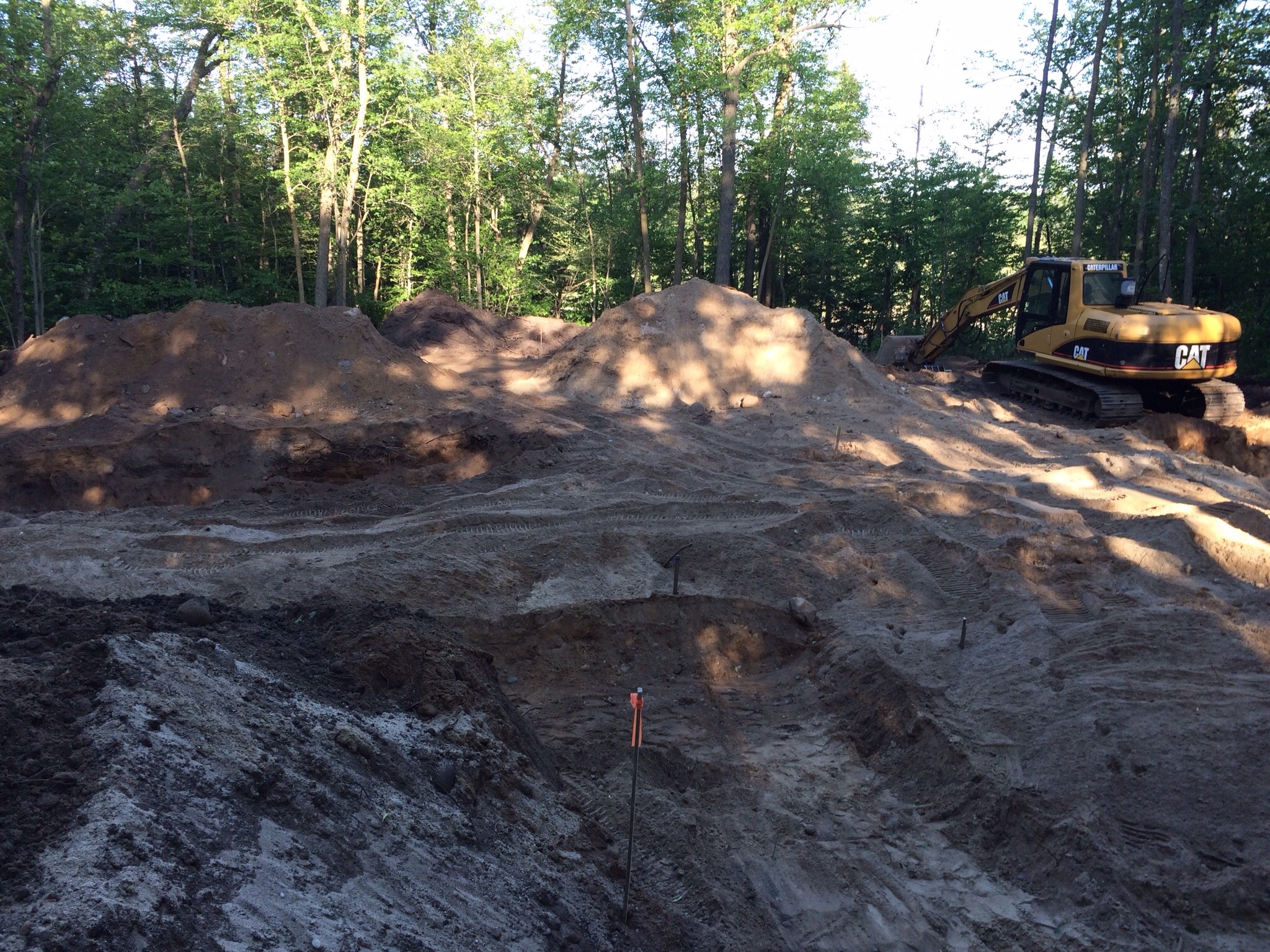
The excavators began work on our home site the week before last. I happened to be at the cabin working on some projects when they rolled in with a huge excavator on a flatbed trailer. Ron Gertz, the excavating contractor, introduced himself and immediately started asking about how the house would be laid out. He told me he needed to develop his own mental picture of what the final grade on the site should look like. We spent a lot of time putting stakes in, measuring and laying out the corners to guide the initial excavating.

The big sandbox

 Ron was concerned that the approach I cleared did not provide the right angle for approaching and entering the garage. He quickly came up with the idea for a circular driveway that would provide the right alignment for the approach as well as improve traffic flow. He even jumped in his skidsteer and quickly brushed out the outline for the driveway. After spending some time with him on-site, it became clear to me that Ron had plenty of experience at this and was quite meticulous. He may come off as a humble farm boy, but he has an engineer’s eye.

The circular driveway in progress

 I went to the site a couple of days ago to check on progress. It was early evening and Ron’s crew had gone home. The circular driveway looked mostly complete, perhaps requiring another course or two of pit-run gravel. The crew had been working on digging the frost footings. Because of the slope, the excavation was over 12 ft deep on the southwest corner.

I found the exposed profile of the excavated hill fascinating; my training in soil science, which I hadn’t used in about 20 years, suddenly became relevant again. The ‘A’ and ‘B’ horizons (topsoil and subsoil) are almost 2 ft thick in places and look extraordinarily rich to someone who is used to working with the thinner soils of the western US. The underlying layer or “parent material” on which the topsoil developed, consists of sand and gravel and ranges from 3 to 6 ft thick. This layer contained a lot of rocks, from grapefruit-sized to over 2 ft in diameter. These were rounded smooth, which is typical of glaciated materials found throughout this area. The excavating crew is separating and stockpiling the rocks for our future use, as we requested. No need to buy expensive rocks for landscaping here!

Footings excavation. Note the whitish layer at the bottom in the background.

 But the really interesting feature of the excavation is the nearly white sand at the bottom. Ever since we bought this place 8 years ago, I have wondered how our little knob was created. The shoreline along the rest of the south side of 5th Crow Wing is relatively flat, but our hill rises up abruptly about 25 feet above the lake’s high water mark. It is generally round in shape at the base, with a curving crest shaped like a whale’s back. According to Wikipedia, this feature may be considered a “kame”, which is formed when material that has accumulated in a crevasse or hole in a glacier drops out the bottom as the glacier recedes. But a kame is usually made of unsorted material, which would not explain the clearly defined sand layer beneath the unsorted gravel.

spodic

Calcium deposits along root channels found in sand layer.

Perhaps the underlying geology of our home site was an ancient sand dune that was later covered by till deposits. This sand dune could have formed along the edge of a lake during an earlier glacial period. Similar sand dune formations can be found, for example on the north side of Height of Land Lake in Becker County. Unfortunately, there is no geologic map publicly available for Hubbard County that would shed any light on what the glaciers were up to in our immediate area. The geology is important to consider when siting our septic system and well. The layers of topsoil, gravel and sand should work well as a filter to keep our sewage from affecting our drinking water and the lake.

The sand itself is beautiful stuff – clean and bright. It is what is known as “sugar sand”, a highly desirable material for rebuilding beaches. I joked to Mel that maybe instead of building a house we should open a sand mine. She didn’t think that was funny.

Right now our home site looks like a giant sandbox. I suggested that Emily haul some of that beautiful sand to the other sandbox for the kids.

The Man from Maskinonge

On June 27, 1839, a man named Pierre Trotochaud entered the United States from Canada (according to a “Declaration of Intent” filed ten years later to become an American citizen). Pierre was born in Maskinonge, Quebec around 1815. Maskinonge, located between Montreal and Quebec City on the St. Lawrence River, was one of the communities where the fur trading companies recruited voyageurs, at least in the early days of the fur trade. Whether or not this practice still was occurring in Pierre’s day, furs were still being moved along the St. Lawrence and opportunities to work in the fur trade were still available to young men looking for adventure.

Unfortunately, the location where Pierre entered the U.S. is not known and could have been any number of places. However, having read up on the history of the Great Lakes region at that time, and having identified the places where Pierre later showed up in and around Minnesota, I think there are three main ways Pierre could have entered the country.

One was at Ft. Michilimackinac, which was an important port of entry for the fur trade at that time. Michilimackinac was located on an island in Lake Huron, at the mouth of the St. Marys River, which flowed out of Lake Superior. Trade goods moved through Michilimackinac, up the St. Marys to Sault Ste. Marie and on to Lake Superior. Trade goods and people were moved across Lake Superior largely by small boats called bateaux, which were wooden, approximately 40 ft long and rowed by a crew of 5 or more. Occasionally these boats were fitted with sails. Birch back canoes were also still in use, mainly for shorter trips along the coasts.

In those days, the American Fur Company dominated the fur trade in the Great Lakes region and had its headquarters at La Pointe on Madeleine Island off the southern shore of Lake Superior. The company had docks, warehouses and stores located in La Pointe. According to the journals of Henry Rowe Schoolcraft, approximately 800 people called Madeleine Island home in 1832. Schoolcraft estimated that only about 150 members of the population were Ojibwe. With the exception of a handful of “white” employees of the fur company, the remaining population were “half breeds”. These were the sons and daughters (and grandsons and granddaughters) of unions between mostly French Canadian men and Ojibwe women. Such marriages were encouraged by fur company officials and if not encouraged, at least tolerated by Ojibwe leaders to facilitate trade.

If Pierre did not come through Michilimackinac, it is possible he arrived in Minnesota by steamboat. In those days, the head of navigation on the Mississippi was St. Peter’s Landing, below Fort Snelling. He could have boarded a steamboat in Prairie du Chien, a fur trading center on the Wisconsin side of the river, or perhaps he boarded at St. Louis, also a major trading center. Many other French Canadians who entered the US at that time landed at St. Peters.

This brings us to the third theory of Pierre’s arrival. He may have relocated from the Red River Colony, traveling what would soon become one of the Oxcart Trails. French and Scottish Canadians were recruited to settle the colony, located near present-day Winnipeg, by Lord Selkirk and others, beginning in the early 1800s. Floods, grasshopper plagues, isolation and other problems made life in the Colony very difficult and led to many of the settlers returning to eastern Canada or emigrating into the US.

Whether Pierre arrived by land or by water at St Peters, he would have found a few makeshift dwellings around the fort and not much else. The inhabitants were mainly French Canadian and mixed blood hunters, trappers and traders. Around that time the US Army began its efforts to move all civilians off the post property. The Army was concerned about a possible Indian attack, did not completely trust the mixed bloods and did not want their dwellings to provide cover for attackers. In 1840, the Army finally removed the remaining squatters by force and burned their buildings. One of those forced out was “Pigs Eye” Parrant, who was just getting his tavern business started. The place downstream from the fort where he relocated was the beginnings of a village originally named Pigs Eye, which later became St. Paul.

Regardless of how Pierre came to what is now Minnesota, it seems clear that he was involved in the fur trade. Given he was about 24 years old, it is possible he began working when he was much younger, perhaps in a warehouse back in Canada. That may have led to a similar job at La Pointe. Alternatively, he may have met and gone to work for one of the major players in the fur trade, who were often conducting business in and around Fort Snelling. These would have included Henry Sibley, William Morrow Rice (who also arrived at St. Peters in 1839), and others.

His work in the fur trade led to meeting a mixed-blood woman from Sandy Lake named Angeline who would be his wife.

Better than Christmas

March and April seemed to last forever when I was a kid. Nothing to do but watch the snow melt and the mud dry. This was also the Lenten season, when I gave up cookies or chocolate for 40 days. Easter Sunday couldn’t come soon enough. My birthday during the first week of April was a bit of a reprieve, unless it fell during Lent, then no chocolate cake for me.

But the hardest part of waiting out March and April was anticipating the opening of fishing season the second Saturday in May. This was the most exciting day of the year for me, bigger than my birthday or Easter Sunday or maybe even Christmas. Fishing Opener meant spending the weekend with my grandparents at Island Lake.

Leading up to the big day, I would go through my tackle box, making sure I had enough hooks, sinkers, leaders and swivels. I carefully untangled the Daredevil spoons and sorted them by color and size. By late April, most of the snow had melted and formed small ponds in the fields surrounding our home. These made perfect locations for casting practice. Having had to slog through the muck a few times to retrieve a lure hung up on some stubble or a rock, I learned to take the treble hooks off and practice with a blank lure.

On the Friday before Opener, my grandparents would pick me up after school on their way to the lake. I don’t think I learned much in school on those Fridays; the anticipation was so hard to contain. Grandpa would have his 14′ Lund loaded in the back of the pickup, inverted with the bow above the cab, and the Hiawatha camper hitched up. I imagined how jealous my classmates were as they watched me climb in.

I always thought the drive to Island Lake, along Minnesota 34, was beautiful, no matter the weather. The scenery heading east from Detroit Lakes transitions from scattered oak stands in fields to dense hardwoods and then to a mix of hardwoods and pine in the hills further east. Having grown up surrounded by farmland, I’ve always been attracted to the beauty and mystery of the Minnesota northwoods. Spotting the first majestic white pine along the highway, somewhere around Toad Lake, was always a highlight for me.

The only part of the drive I didn’t like was the annual stop at Hanson’s Flyway on Height-of-Land Lake. Lawrence Hanson ran a small bar and gas station along the highway, and loved to tell stories to anyone who would listen. As I learned growing up, Grandpa loved to stop at small roadside joints for a beer or two and a story or three. So I would get a candy bar and bottle of pop and sit and wait, spinning on a bar stool until it was finally time to go.

Island Lake lies northeast of Height-of-Land in eastern Becker County. In addition to several islands, the lake features an assortment of points, bars and other structures, which make for excellent walleye habitat. The fishing was great, as well as I can remember, in my early years. Like with most lakes that receive a lot of fishing pressure, fishing at Island seemed to decline over time. But that didn’t discourage us from coming back every year.

After setting up the camper and unloading the boat, Grandpa and I would sit down and go through our tackle to plot our strategy. We’d check the rods and reels, changing line if necessary. Grandpa taught me how to tie knots, pick sinker weights and put together the best presentation to fool the wily walleye. For me, the anticipation continued to build. I couldn’t wait for Opening morning.

We usually headed out just after daybreak, with Grandpa at the helm, Grandma on the middle bench and me at the bow. We had our favorite spots: the Moosehead, the Sunken Island, Barrel Bay (“like catching fish in a barrel”), and others. Grandma would hand out the minnows, but she would not touch the leeches. We would fish until mid-morning, come in for lunch, and then head out again in the late afternoon and fish until dark.

I always liked fishing in the evening the best, enjoying the colors of sunset, the silhouettes of the pine trees along the shore and the calls of the loons. According one of Grandpa’s favorite stories, I didn’t always like the loons. One evening when I was probably 7 or 8, I said “I wish those loons would quit making all that noise.” Apparently, it was affecting my concentration!

Most years we were joined at Island Lake by Uncle Dewey and Aunt Elsie from Brooklyn Center. Uncle Dewey was Grandma’s only brother and a World War II vet who fought all the way across Europe. Being really into all things WWII, I was fascinated by him. Dewey wasn’t one to tell a lot of stories, but once in a while he would talk about his experiences and answer my questions. Aunt Elsie always brought really decadent treats to share and had an infectious laugh.

Uncle Dewey drove a fancy Buick Electra, the first car I ever saw with electric windows and air conditioning. He had a contraption mounted on top that would allow him to load and unload the boat by himself. Grandpa gave him a hard time about living in the lap of luxury. Grandpa would also grumble about Mitzi, the little poodle that went everywhere with Elsie.

When I was little, I thought I would always want to be with Granydpa and Grandma at Island Lake. But that changed when I got to high school. It so happened that the high school prom fell on the same weekend as the Opener. Although I didn’t have a girlfriend, I still asked a girl to prom, because that’s what everybody did. Grandpa and Grandma seemed to understand. Looking back now, I would rather have gone fishing.

A family at Sandy Lake

My family’s Ojibwe ancestry has been traced back to a woman named Margaret or Ma Chay, who was born around 1800 at Sandy Lake, which was a major Ojibwe village located in what is now northeast Minnesota in the 18th and early 19th century.   According to Anton Treuer’s book The Assassination of Hole in the Day, Hole in the Day the Elder was a prominent chief at Sandy Lake and his son Hole in the Day the Younger was born there.

Sandy Lake was also the site of important trading posts during the fur trade era.  In 1794 the Northwest Company established a post on the west shore of the lake that remained in operation until after the War of 1812.  A law passed in 1816 required all trading with Indians be conducted by American citizens, which forced the Northwest Company to sell its holdings in the U.S. to John Jacob Astor. Astor’s American Fur Company operated the old fort for several years before establishing a new fort on the Sandy River, which connects Sandy Lake to the Mississippi. Several other independent trading houses also may have existed in the area.

The trading posts are important to our family’s story because it is likely that Margaret met Alexander Blair at one these posts. According to government records, Blair is listed as the father of Margaret’s four children: Angeline (born 1819), Antoine (1827?), Edward (1829?) and Alex (1840?).  Given the time span between the oldest and youngest, it appears that Margaret and Alexander had a long-term relationship.

Unfortunately, I have found no solid information for Alexander beyond his name.  Having read as much as I can about the fur trade in the early 19th century, including employee lists of the trading companies, I have yet to find any mention of him. I have found other potential clues. There was an Alexander Blair who served in Canada in the British army during the War of 1812. Is it possible that our Alexander stayed behind after the war? There are also a couple of Alexander Blairs who show up in city directories for Detroit and other cities in Michigan and upstate New York in the 1840s and 1850s.  Was our Alexander one of many white men who, after making their fortune in the fur trade, abandoned their native families and returned to “civilization” to start another life? It is unlikely that I will find any connections between these men and our family, but I’ll keep looking.

Unfortunately, there is also little information about Margaret.  Her name shows up in the “Half-Breed Scrip” report, which investigated the use of scrip to issue land claims under the 1854 Treaty. The investigating commission had as one of their sources a trader named Peter Roy, who claimed to know Margaret. Roy stated that she and her three children who filed claims for scrip in 1864 were from Sandy Lake and were mixed blood Ojibwe of Lake Superior.  The commission ruled that Margaret was not eligible for scrip because Margaret was married before 1854, and therefore was not a head of household when the treaty was signed. Apparently, because Margaret was ineligible for scrip, the claims of her children were also rejected. Census records indicate that Margaret lived with one of her sons through at least 1870 and the sons and her daughter all settled together at Little Rock Lake north of present-day Sauk Rapids (the next part of the story will be in a future post).

My sense is that Alexander Blair died at Sandy Lake. I have no way of verifying this, of course. The burial grounds at Sandy Lake have long since been covered up by lake homes and condos.  Or was he buried along side a trail or portage somewhere? Did he drown? There are many possibilities, all of which suggest Alexander Blair was one of many men involved in the fur trade who are lost to history.