After the Storm

OLYMPUS DIGITAL CAMERA

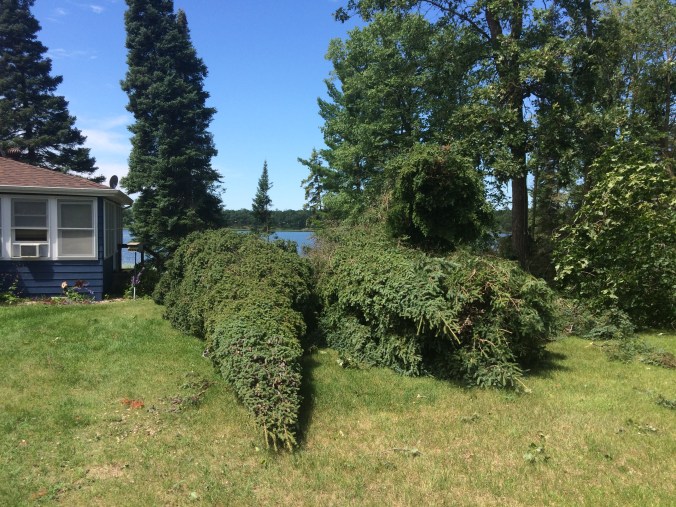
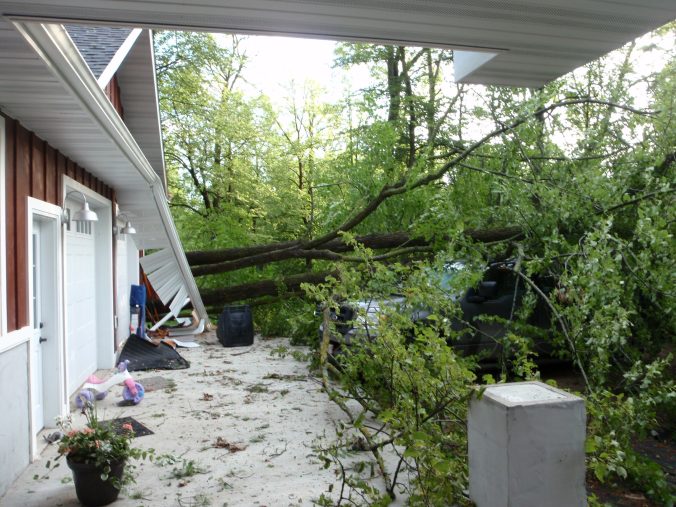
The scene that greeted us the morning of July 21st.

Wednesday, July 20th of this year was another uneventful summer day. At the end of the day, as is my habit, I checked the weather on my iPhone before going to bed. We were in a severe thunderstorm watch, but the radar showed nothing in our immediate vicinity.

At about 1 am that night we were awakened by the storm. Through the strobe-like flashes of lightning we could see trees waving wildly in the wind. We went back to sleep thinking we may have branches and leaves to clean up in the morning.  What we did not know was the storm hitting us was massive and had formed a bow echo on radar, which is an indicator for damaging straight-line winds.

The next morning I took a look around the south (lake-facing) side of the house to see if we’d lost any trees. Other than an accumulation of branches and leaves on and around the patio, there did not appear to be much damage. I finished my coffee, showered and got ready to go to work. (I am working again this summer as an Aquatic Invasive Species inspector.)

When I went out to start loading my truck I went around the northeast corner of the house and could not believe my eyes. A gigantic clump of basswood trees had been blown over, clipping a corner of our new garage and landing on both our vehicles.

I went back inside to let Mel know I would not be going to work that day.

After recovering from the initial shock, I started making calls to insurance companies. Although our brand new house was damaged, we were not upset. Insurance would cover the repairs, which we would have our current contractor (who is still on the hook for a few other punch list items) complete.

We called on friend and neighbor Mike H. for help with getting the tree off our vehicles. He and wife Gail spent most of the day with us cutting and hauling away branches. Mike is a retired tree-trimmer, so his expertise was invaluable. Our daughter Emily’s fiancee Joe J. also was a big help, coming up with a plan to jack the huge tree trunks up so we could back the vehicles out.

We were quite surprised to find that the damage to our vehicles was not as bad as it first appeared. The pickup  (with minimal insurance coverage) got a few more dents and scratches, which blended in with all the other dents and scratches. Although the Outback did not look bad, the body shop estimate still came at over $6000!

But that’s why we carry insurance – no big deal.

The storm’s real damage was down the hill at our cabin.  There we lost nearly all the mature balsam fir trees that provided us shade in the summer and a windbreak in the winter. We also lost a number of other trees between us and the neighbors and even more in the woods behind the cabin. Straight-line winds normally break the tops off trees, which is bad enough. But we had recently had over 12″ of rain, softening the ground so the trees went over, roots and all.

OLYMPUS DIGITAL CAMERA

IMG_1412

IMG_1406

The remaining three balsam firs on the left had to be taken down, as they were partially uprooted and leaning toward the cabin.

Our cabin is currently empty, now that we are in our new home. We hope to use it as a guest house or possibly as a vacation rental property.  We were fortunate that none of the trees came down on the cabin and the damage to our personal property was minor. This stuff is easily replaced.

What can not be replaced are the beautiful mature trees that framed the property and provided its  unique character. The cabin no longer peaks out from under the fir boughs – it sits naked in plain sight now.  These trees were planted and nurtured by the original owners of the property starting back in the 1950s. They had sheltered innumerable family gatherings, graced the property with their fragrant boughs, and took the bite out of the prevailing northwesterly winds that scream across the frozen lake in winter.

We will replant, of course, and try to reestablish some shade with fast-growing aspen and poplar. But we will not see the likes of these beautiful trees on the property again, at least not in our lifetimes.


Almost a House

IMG_1265

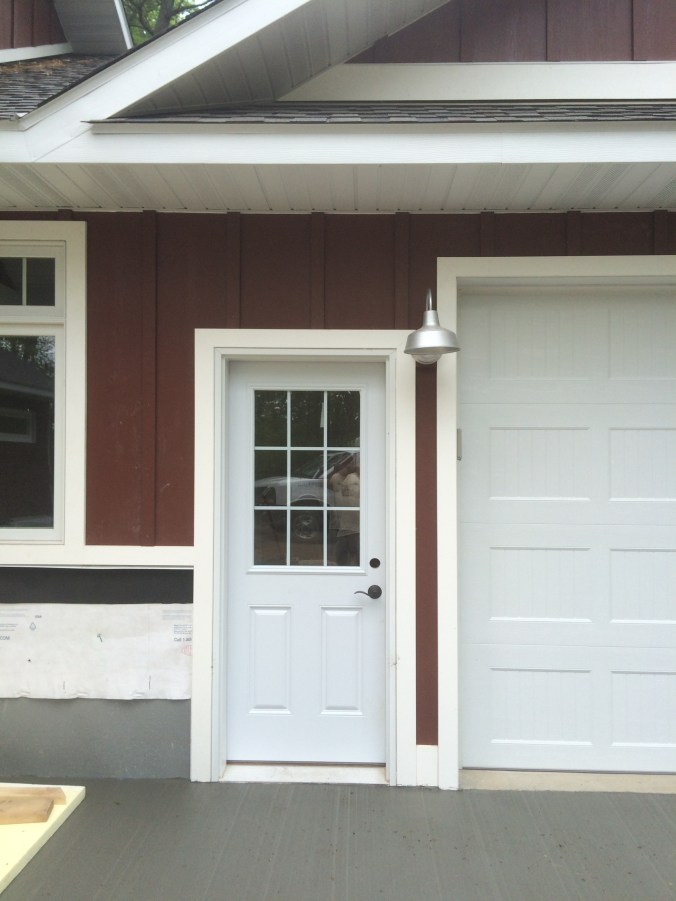
We’re almost there – just waiting for the concrete guy to come back to polish the floors one last time, and for the tile guy to seal the grout in the showers. A year ago we started with high hopes – our custom design was perfect and we had the best contractor in the area, who told us we would be in by the fall – of last year.  After months of waiting for subcontractors to show up, worrying over details (“the wood stains don’t match!”) and lamenting  the lack of communication with our general contractor, we have moved beyond frustrated to complete mental exhaustion. But we are finally seeing the light at the end of the tunnel. We have been incredibly blessed and fortunate.  Soon, we’ll be moving in to our new house.

We should be really excited about this. But we’re approaching the move-in with not a little anxiety. What if our design is seriously flawed? Will we stay warm enough in the winter and cool enough in the summer? Will we still like our cupboards/windows/floor/whatever in 10 years or 20? Should we have made this room bigger? Should have put in more windows? People say you should build two houses, the second one to fix all the mistakes you made the first time.

But our uneasiness may have deeper sources.  It is too easy to fall into the habit of thinking the new house will fix all our foibles – we’ll be better organized, we’ll clean up after ourselves, we’ll exercise more and eat and drink less.  The new house will bring out our creative selves, make us better gardeners, better cooks, better hosts. I’ll write more. We’ll make a strong effort to be the people we ought to be, but the reality is we will no longer have the lack of storage space or sunlight or outlets or counter space as excuses for being lazy slobs.

We have a mountain and several foothills of stuff in our pole shed and more in off-site storage. We know it won’t all fit. We are reluctant to get started – not the least because the job will be more like an excavation than an orderly move. As the year went on, stuff got heaped on stuff, stuff was pulled out early, from the bottom of piles, causing avalanches of stuff.  We started packing over a year ago, before Emmaville was sold. We knew just where everything would go and had a brilliant plan to keep it all organized. Now we can’t remember what we have where. Just as the building process had peaks and valleys, we anticipate the moving process will have moments of joy (“Oh, I forgot we had this! This will look perfect.”) and moments of exasperation (“Why did we keep this. What the hell are we going to do with it?”).

Hopefully in another year, we’ll find ourselves relaxing on our patio after a great day spent tending the garden or creating something beautiful and will realize we are content. Even if there is a sink full of two-day old dishes, a basket of unmatched socks on the couch and boxes in every room still waiting to be unpacked.


A Tragic Loss

Sauk Rapids Sentinel article

When I last posted on the Minnesota History page, my great-great-great-grandparents Pierre (Peter) and Angeline Trotochaud were homesteading on Little Rock Lake near present-day Rice, Minnesota in the 1850s and 60s.  The following is reproduced from the Sauk Rapids Sentinel, dated August 20, 1869.

A son of Peter Trotocheau of Little Rock Lake, ten miles above Sauk Raids, was killed by a Chippewa Indian, on Monday last. The circumstances as we have gathered them are as follows: Four Indians, said to be of the Mille Lac band, arrived at Little Rock a short time before the murder, and in the sports a wrestling match took place between one of them and Trotocheau, a young man about 18 years of age. He proved too much for the Indian and threw him. The young man seemed to think no more of the affair, and engaged in a game of cards. He was out in the open air, seated on the ground. One of the Indians laughed at his comrade for allowing the boy to throw him, and jeeringly asked him why he did not do as he said he would.  Upon this the murderer went into a lodge close by, procured a knife, approached the young man, and while his head was bent forward gave so heavy a blow with the knife on his forehead that it penetrated his head, splitting it nearly open, from the effects of which he died almost instantly. The murderer ran into the woods, pursued by some of the Halfbreeds residing there, accompanied by two other Indians; but he made his escape, and we believe he has not yet been heard from.  Mr. Osgood, Sheriff of Benton County, we understand, has gone up to the Chippewa Agency to get the assistance of the Agent in arresting the murderer.

The person murdered is quite a boy, but we never heard aught against him. His father is well known in our county as a good industrious Canadian, and has the reputation of being a very honest man. He is almost crazy over the tragical death of his sone, and we really hope that something will be done to bring on the murderer condign punishment.

These savages must be taught that they cannot commit such acts with impunity….The mother of the murdered boy is, we think, one-eighth Chippewa. She is a quiet, inoffensive woman, and much respected by those who know her. She is the mother of some eight or ten children, but we understand that this boy was her only son. This poor woman has the sympathy of all her acquaintances.

Grandpa Ray and Will Rogers

Ok, so Grandpa never met Will Rogers.* But he felt the same way as Will, who once said, “I never met a man I didn’t like.” Grandpa could make friends with just about anybody. He was especially good at making friends with people who knew where the fish were biting.

Of course, Grandpa met a lot of people over the years, at the Cozy Coach in Westbury, delivering mail, as a county agent, selling crop insurance….Even those who didn’t know him in the area knew of him. At Emmaville a couple of years ago, I met a man named Ron who grew up around Two Inlets, another small berg in the middle of nowhere, and who enjoyed the occasional beer in the Two Inlets Store. Grandpa and Grandma had some good friends who were Ron’s neighbors and often met them for beers around the little horseshoe bar at the store. Ron didn’t recall Grandpa by name when I mentioned him, but when I described him, he knew exactly who I was talking about: “oh, yeah, real loud guy, laughed real loud and drank a lot of beer.” Yeah, that was my Grandpa.

Grandpa loved to stop at small roadside taverns (he called them beer joints) when he traveled, and always managed to strike up a conversation with someone. Story after story was told. One round would lead to another, and the next thing you know, Grandpa was planning a fishing/hunting/camping trip with the guy. He and Grandma had friendships with people all over the country, dating back to the 1940s. Year after year, Grandpa or Grandma would call them up just to see how they were.  Grandma was a good letter writer and kept up correspondence with a lot of the folks they met.

Every summer, all summer long, Grandpa and Grandma would have company. Friends would come from far and wide to stay and do some fishing down at Floyd Lake. Grandpa never passed up the chance to take his guests fishing.  He reveled in watching their reactions when the sunnies were really biting.

Grandpa was fascinated with the way people lived in other places and in other cultures. He often told the story of some folks from Chicago who came for a wedding. Upon arrival at my grandparents’ farm in the woods, the city folks marveled at the surrounding “wilderness”. One man wondered how anyone could make a living where there were no offices or factories. After Grandpa had given the bride and groom a celebratory ride in a manure spreader behind his tractor, one of the Chicagoans asked about the contraption. Grandpa asked the fellow if he had been in the army and if he remembered “honey wagons.” The light of recognition went on; they had found a way to relate. That story always made him chuckle.

In their later years, Grandpa and Grandma spent the winters near Brownsville in Texas. After spending a few years trying to figure out how to fish the Rio Grande, Grandpa befriended a Mexican-American guy he met on the river.  Soon he was having success on the Rio, but he also enjoyed visiting the man and his family and learning about their lives.

A more poignant story involved Grandpa’s one and only elk hunt in Montana.  After several days of hard hunting, he was still waiting for an opportunity to see elk within shooting range.  Driving near Neihart in the Little Belt Mountains, Grandpa and his friend Darrell Abbott, a rancher from Gilt Edge, spotted a herd of cows several hundred yards away.  Grandpa decided it was his last best chance, got out of the truck and took a shot. It was a good one – he knocked a cow elk down. While Darrell continued hunting, Grandpa hiked up to his kill and began dressing out the elk.  As he was working away, he began to wonder how in the world he was going to get the elk down from the mountainside.  Just then, another hunter came along on horseback and offered to help.  He showed Grandpa how to quarter and bone out the animal and together they packed the meat down to the truck.  By the time they were done, Grandpa had a new friend.

The man was a local, a retired prison guard and offered to host Grandpa the next year on another hunt.  Grandpa was excited about the trip, having talked with his friend during the year to firm up plans.  Then he got the sad news: his new friend was killed in a car accident, pulling out of his driveway.  Grandpa and Grandma traveled out to Montana for the funeral of his friend. He never went on another elk hunt.

I often wish I had friends like Grandpa did. I tell myself these are different times; people don’t socialize like they used to do. But really, the formula remains the same: make a friend, be a friend. Stay in touch. Make plans and follow through. Whenever I think about the way Grandpa lived I am reminded that having friends is a responsibility.

Another famous man Grandpa actually did meet, Hubert Humphrey, once said, “the greatest gift of life is friendship and I have received it.” Grandpa may not have said it in so many words, but his life reflected this truth.


*Sorry, I couldn’t resist using that title as a hook!


Life at Little Rock Lake

When we last visited Pierre and Angeline (Blair) Trotochaud, they were living at Little Canada on the outskirts of a young St. Paul in 1850. The next data point is 1856, when Pierre filed a land claim in what was to become Benton County. The claim was located next to his brother-in-law Antoine Blair, who had settled there sometime before 1849. These homesteads were located on the western shore of Little Rock Lake, about 1.5 miles east of the present-day town of Rice. The area was an important historical nexus, where the Oxcart Trail ran along the east side of the Mississippi River, where several trading posts were located and where Peace Rock, a granite outcropping along the river, marked the boundary between the Ojibwe and the Dakota nations.

At the time Pierre had proved up his homestead claim, he and Angeline had five children: Margaret, born in 1845, Sophia (1847), Peter (1850), Amelia, the future Mrs. Mitchell Spry (1852), and Eliza (1855). A second son, Moses, came along in 1857.

Minnesota had been a territory since 1849 and was on the verge of statehood. A final territorial census was completed in 1857, which listed “Pierre d’Autrechaud” as a hunter. This suggests Pierre was paid to hunt, probably to supply local merchants. This was a natural extension of Pierre’s previous life in the fur trade.  David Gilman, previously mentioned on this blog (see “Uncle Antoine”) owned a hotel at Watab and may have employed Pierre to supply the dining room. Pierre’s game bag probably included deer and waterfowl. Bison and elk had already been wiped out in most of Minnesota by that time. The continued loss of game in the area probably made this a short-lived occupation for Pierre.

The 1860 federal census lists “Pierre Trotocheau” as a farmer with real estate valued at $400 and personal property at $100. Oldest daughter Margaret, then 15, was listed as a domestic servant. Margaret probably worked at the Watab hotel, as there does not appear to be anyone in the area in 1860 who had the wherewithal to employ servants. Another son, Joseph, was born that year to Pierre and Angeline.

The 1860s were a turbulent time in the area. More and more settlers were moving in, increasing the demand for land. The Ojibwe were subject to continuing pressure to cede lands and move to reservations. Their old enemies the Dakota (Sioux) had already been moved on to reservations along the Minnesota River in southern Minnesota. In August 1862, The Dakota, fed up with their treatment by Indian agents and traders, started attacking white settlements beginning what became known as the “Sioux Uprising”.

The Ojibwe were approached by emissaries from the Dakota to join them in the war. Hole in the Day the Younger had made himself the leader of the Ojibwe, a position he inherited from his father Hole in the Day the Elder and maintained through oratory skills and force of will. Hole in the Day the Younger, who was based at Gull Lake, decided to join the Dakota and had sent his own emissaries to Leech Lake and Red Lake to rally the other bands. Hole in the Day was also the nominal leader of the Ojibwe people living in the large village between Watab and Little Rock Lake, near the Trotochaud and Blair homesteads.

Had the Ojibwe entered the war, white settlements along the Mississippi all the way down to St. Paul would likely have been attacked and a great many more lives lost. Credit is given to Father Francis Pierz, an Indian missionary priest, for convincing Hole in the Day to choose peace over war. Father Pierz had been a missionary to Indians around Lake Superior since the 1830s and had been assigned by the new bishop in St. Paul to minister to Indians and whites along the Mississippi for 100 miles above St. Paul. Father Pierz established a parish at Crow Wing in 1852 and parishes at Belle Prairie, Swan River and Sauk Rapids in 1853, St. Cloud and St. Joseph in 1854 and St. Augusta in 1855.

For the Trotochauds, the nearest parish would have been Sauk Rapids, about 12 miles to the south. I have not found any information to indicate whether the family were practicing Catholics. There may be mention of them in Fr. Pierz’s baptismal register, which may still reside at the Belle Prairie parish.

The Trotochaud family continued to grow at Little Rock Lake. A son, Antoine, was born in 1862 a daughter, Delphine, in 1866 and another daughter, Christine in 1869. According to the 1870 Census, the Trotochaud homestead was still valued at $400 but the personal property was now valued at $500. Around this time, Pierre Trotochaud was listed as one of the top producers of wheat in Benton County.

In spite of their prosperity, the Trotochauds experienced a shocking tragedy in 1869. More on this to follow in the next post.

Deer Camp

Grandpa Ray and Grandma Arleen made deer camp a very special experience for their grandsons. They passed on to us a hunting heritage that will, hopefully, continue in our family for years to come. Grandma was the “voman in the voods” as one old Norwegian who encountered her in the woods put it. Indeed, a woman hunting back in the 50s and 60s was almost unheard of. But Grandma was out there, along with her daughters – even when they were pregnant. Grandma was a crack shot and brought many deer down with her lever-action .32 Winchester. She was also a wonderful camp cook who had us looking forward to every meal.

Grandpa was just as excited as us kids to go to camp. He started preparing sometimes as early as September, shopping for the best bargain beer he could find. It had to be cheap because he bought a lot of it – 25 cases or more each year. That is a lot of beer but we usually could count on a lot of visitors to our camp deep in the Beltrami Island State Forest near Roseau. There were the Weber cousins who camped a few mile south of us, the Hoaglund crew who had a cabin nearby, the McCleods from back home, and others who would stop by our camp to inquire about our hunt and drink a beer or three. That is when the stories came out.

Deer camp stories, whether told around a campfire or around the table in the cook shack, were the highlight of every evening. The storytelling was always a raucous affair, the storyteller getting louder with every round of beer. It was as if we were making up for all the quiet stillness we practiced during our morning hunts. Sometimes that was practiced stealth, and sometimes it was just trying to avoid any loud noise because we were hung over from the previous evening’s festivities.

Beltrami camp

Grandpa Ray (lower right) and crew in camp, mid-1980s

While Grandpa loved a good party in camp, he was serious about getting as much venison as we could. He put as many if not more hours in the deer stand as any of us. Grandpa was especially focused when it came to conducting drives. Both the drivers and the standers were given explicit instructions. Whether we got a deer or not, we could count on an extensive postmortem from Grandpa on what went right or wrong.

Grandpa was also adamant that we get everything out of the deer we could. All the bragging we wanted to do about our latest kill was usually stopped short when he asked if we remembered to harvest the tongue, the liver and especially the heart. Per Grandpa, these delicacies were not to be wasted. Grandma often made pickled heart right in camp, and sometimes fried up fresh liver for dinner (both acquired tastes as far as I was concerned).

Grandpa liked securing some “camp meat” too. This usually involved cutting up a fawn or small doe and consuming it all during the week of camp. The way Grandpa saw it, nothing was better than fresh venison and there was no sense in wasting a tag on a small deer. That being said, Grandpa usually asked one of his sons-in-law secure the deer in an out-of-the-way place and butcher it there so as to avoid incriminating himself.

Occasionally, over after-dinner drinks, Grandpa would wax philosophical.  He talked about how lucky we were to be able to hunt, to have public land to hunt.  He talked about how public land was not available in many other states he had visited.  He thoroughly enjoyed being out in the woods in a make-shift shack on wheels, eating simple but hearty meals, and sharing the experience with family. He was right; we were very fortunate.

When I got my first full-time job after college, I made sure I saved enough vacation time to go to deer camp. We encountered tough hunting conditions that year and for this and other reasons we decided to pull camp early in the week. Grandpa felt bad I had taken all my vacation time, so he and I hunted around his place. Later in the week, we checked out a place in the White Earth State Forest that Grandpa used to lease from the county for grouse and duck hunting. I shot a forkhorn buck that day and eventually we found a new place for our camp for the following year.

Unbeknownst to me at the time, that next year was the last time I got to hunt with Grandpa in Minnesota. The following year my career took our family further west, too far to come home for hunting. It would be another 11 years before I would be back for the Minnesota deer season.

Now, almost 30 years later, we are still hunting from the same camp. My dad is now the Grand Old Man of deer camp and my mom is now the cook. I still hunt with my brothers and cousins and now, our kids, maintaining the traditions we learned from Grandpa Ray.

We just don’t drink as much beer.

Zhingwaak Revisited

IMG_0203We are fortunate to have a number of mature Eastern white pines (Pinus strobus), the tree the Ojibwe call zhingwaak, on our land. For me, the white pine symbolizes my love for this place called Minnesota. Tracing the silhouettes of pines at sunset on Island Lake as young boy, I first knew the joy of observing nature.  I’ve wanted to live among the pines ever since.

The white pine, along with its cousin the Norway or red pine (Pinus resinosa) attracted the first logging companies to Minnesota Territory back in the mid-1800s. Pine boards built thousands of homes, barns, storefronts, churches and schoolhouses throughout the Midwest.

Pine was in such demand during the settlement era that logging companies took every tree they could find, leaving barren landscapes wherever they went.  The greed of the timber barons provided impetus for the allotment acts that broke up the White Earth and Leech Lake reservations and allowed the taking of most of the land originally reserved for the Ojibwe by treaty.

Today, only remnants of these once-great pine forests can be found in scattered locations in northern Minnesota. Perhaps the most notable of these pine islands is the Lost Forty, located northwest of Grand Rapids.  A surveying mistake in 1882 resulted in the preservation of a small piece of Minnesota’s pre-settlement forest. (You can get a glimpse of the Lost Forty in this YouTube video: https://www.youtube.com/watch?v=lSBTlJGCitE)

The white pines on our land are probably “second-growth” trees that got established after the logging boom, which makes them at least 100 years old. They form a crown atop the knob we are building on, visible from across the lake and from the river outlet along Crown Point Road (I like to think the road is named after our little hill).

We reluctantly took down one of these majestic trees to make room for our house. We want to remember and honor this tree so we are incorporating as much of it as we can into our new home. After my friend Mike the DNR Forester felled the tree for us back in April, I hauled several of the logs to a local sawmill to have them sawn into 2.5-inch slabs which were then kiln-dried and planed. Last September, I picked up the sawn pieces from the mill and began making what will become “floating” shelves throughout the house.

IMG_0912

We are also having the top for our kitchen island made from these slabs. Athough it may not be practical to leave the bark on the island top, we’ll retain the natural shape of the edges.  Our fireplace will feature the slab on the far right of the above photo, bark and all, as the mantel.

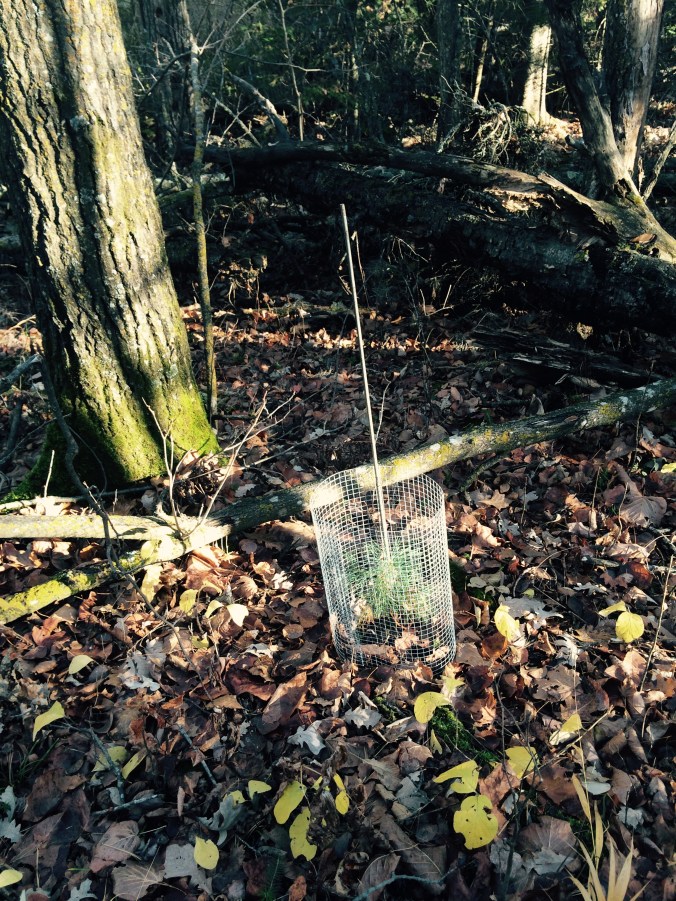
Meanwhile, as I poked around the woods this fall, I began to locate white pine seedlings coming up around our building site.

IMG_0952

To keep the deer from eating the terminal buds on these trees this winter, I erected little fences around each tree.

white pine

I’ll remove the fences in the spring to avoid inhibiting their growth.  Although Mel and I will be long gone when these trees become mature and add to the beauty of Crown Point, we hope our descendants and others will enjoy them for years to come.

A Visit to Sandy Lake

image

A few weeks ago, as Mel and I were returning from my nephew’s birthday party in northern Wisconsin, I suggested we make a side trip. We were in no hurry to get home, so Mel agreed.

“Where are we heading?” she asked.
“Sandy Lake; it’s near McGregor.”I replied.
“What’s there?”
“I don’t know – hopefully something telling about the history of the place.”

Instead of heading out of Duluth on Highway 2, we took Highway 210 to McGregor, then turned north. We saw no signs indicating any historical sites ahead but I thought there had to be something commemorating the place in Minnesota’s history. I got on my smart phone (Mel was driving) and googled Big Sandy Lake. Just as images of historical markers popped up, we happened by those very markers along Highway 65.

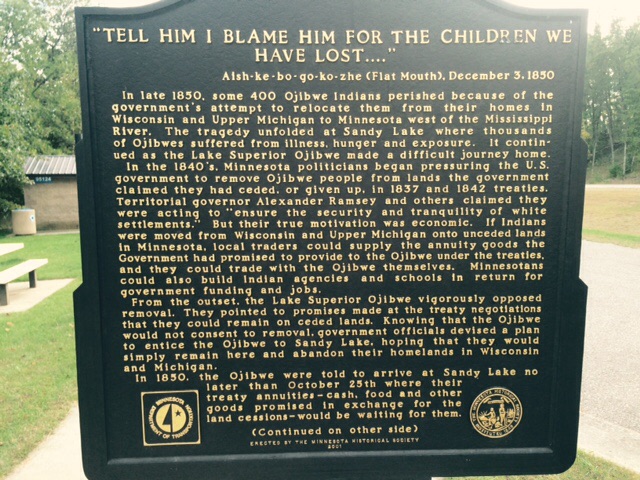
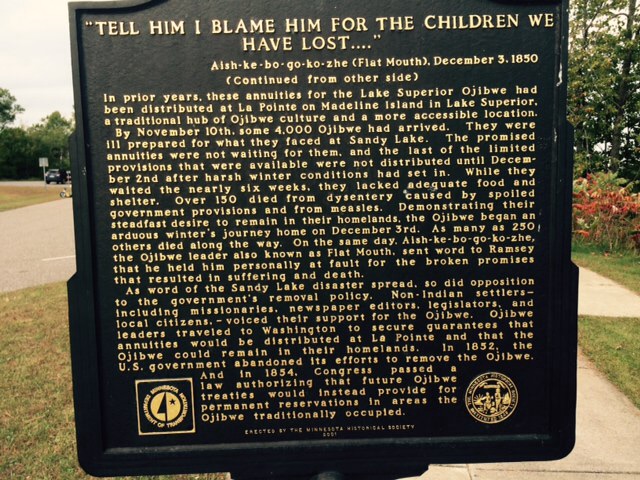
The markers are located at a wayside rest with a beautiful view of the lake. For some reason, the wayside rest was barricaded off, but we parked on the shoulder and walked in. I was surprised to find a detailed description of the Sandy Lake Tragedy that pulled no punches regarding the white leaders involved. The marker clearly describes the motives of Territorial Governor Alexander Ramsey and how the Ojibwe were wronged. High school history classes in Minnesota discuss Ramsey as a prominent figure in the state’s formation. I wonder whether his role in the Sandy Lake Tragedy is talked about in those history classes….

image           imageWe continued north toward the area where I read the old trading post was once located. Another surprise: a well-maintained recreational area at the outlet of the lake. The Corps of Engineers maintains a flood control dam at the outlet and has developed an attractive park, including more historical markers.

image The most recently installed marker, commemorating the Sandy Lake Tragedy, was established by descendants of the victims representing several Ojibwe tribes. Called the Mikwendaagooziwag Memorial, it stands on a small knoll that also is home to a very old cemetery.

image

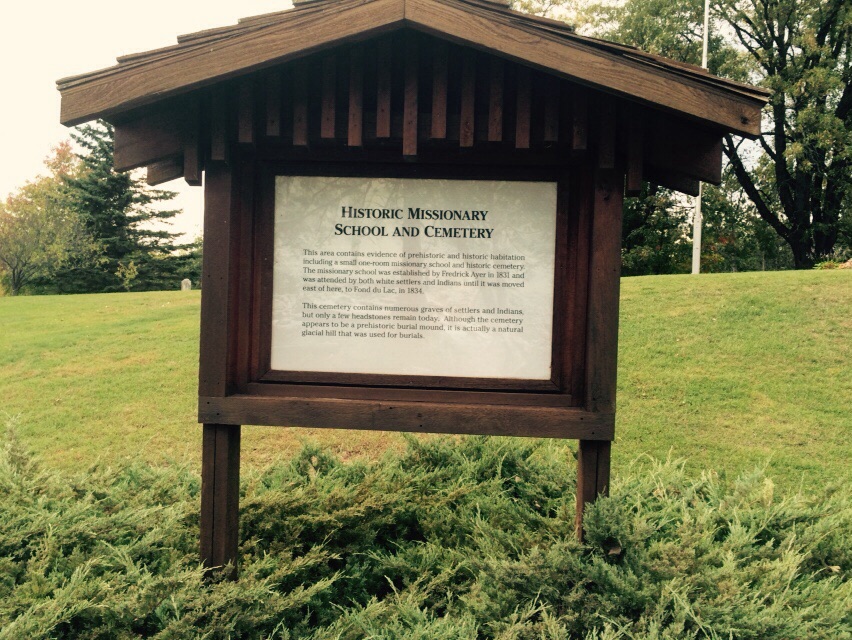
Based on the information on all the markers, it became clear that the main Ojibwe village was located here or very close nearby. The missionaries Frederick and Elizabeth Ayers established a mission here in 1831, and later moved it to Fond du Lac in 1834. Interestingly, the Ayers missionary life paralleled the journey of our family. Prior to Sandy Lake, the Ayers served at LaPointe, and they later appear in the 1849 territorial census somewhere north of Little Rock Lake, as the nearest neighbors to Antoine Blair. Whether there this is coincidence or there is a real connection between the Ayers and our family depends whether Alexander Blair was French Canadian or Scottish. If he was from Scotland, he would likely have been Presbyterian, like the Ayers. On the other hand if he was French Canadian and Catholic, he and his family would have had very little to do with the Protestant missionaries.

According to the historical marker on-site, the cemetery includes Indian and non-Indian graves. The marker clearly points out that, although the small hill resembles a burial mound, it is a naturally occurring glacial feature. Only two gravestones remain, both of which are dated in later settlement days. As I reflected on this information, it occurred to me that Alexander Blair and other members of our family may have been buried here.

image

Given its strategic location on the portage between the Mississippi and the St. Louis River and Lake Superior (Savannah Portage State Park is located near the lake’s northeast corner), one can imagine this area bustling during the height of the fur trade. Early American explorers, including Zebulon Pike, Stephen Long, William Cass and eventually Henry Rowe Schoolcraft, all stopped at Sandy Lake to rest and re-supply. The members of our family who lived here witnessed a very important era in Minnesota’s history. The same can be said for the family members who later settled at Watab, which will be the subject of my next post.

The Traveling Barn Door Finds a Home

Growing up on the Spry farmstead before the age of electronic entertainment, my siblings and I played a lot of ball in the yard. There was (and still is) a glacial erratic in the middle of the yard the top of which was exposed through the grass. This patch of rock made a perfect, permanent home plate. First base was a Norway pine sapling we planted when we first moved to the farm. Mom’s long-suffering snowball bush (a high-bush cranberry) served as second base, as well as a sideline marker for football games. Third base was usually a flattened cardboard box.

Our makeshift field was the setting for acting out our baseball fantasies, imagining we were in a major league park. We even had our own version of the Green Monster, the south side of the old barn, which officially measured 217 ft from home plate in left center. I painted that number on the barn in white paint, with large numbers and a smaller “ft”, just like the outfield fences in Met Stadium.

The barn hadn’t been used for its original purpose, milking cows, for decades. Inside, a few rusted stanchions hung from the beams. In the hay loft, several rotting horse collars were perched in the crooks of the rafters. For the first few years after we moved to the farm, Dad raised feeder pigs in the barn. My after-school chores included “slopping the hogs”. After the pigs were gone, the barn sat empty again.

When my siblings and I returned to the farm on annual summer visits as young adults, we noticed the old barn was nearing its end. Each year, the sides of the ground floor leaned further north, as the classic barn roof with its aluminum cupola, still stately but sagging a bit in the middle, slowly sank to the earth.

On one summer visit some 20 years ago, Mel and I learned the Callaway Volunteer Fire Department was scheduled to use the barn for practice. We salvaged two doors from the barn, the main door from the front and a side door near the silo. We were visiting from our home in Montana at the time and hauled the doors all the way back on the roof of our Jeep Cherokee. We had no idea what we were going to do with them, but we thought they were cool and reminded us of home.

The larger door. The nicks and gouges in the middle are from the steel fencepost we used to prop the door shut on the barn.

The larger door. The nicks and gouges in the middle are from the steel fencepost we used to prop the door shut on the barn.

From Montana, the doors moved with us to Idaho, from there to New Mexico, and finally back to Minnesota when we bought our cabin on 5th Crow Wing Lake. We used the smaller door as a headboard for a while and the larger one to display antique fishing lures but mostly they stayed in the garage and collected dust. Although we spent thousands of dollars renovating and redecorating every house we owned, we never permanently installed the doors in any house. We knew we’d be moving on at some point and didn’t want to leave them behind.

When we started designing our house last winter, we spent a lot of time looking at the Houzz website (or what we call house porn), for ideas. We learned about the latest decorating craze: barn doors. These are doors that slide along a track and look old, for which you can find hardware on at least a dozen sites on-line. You can even order doors made from reclaimed wood. Designers have learned what we have known for years: old barn doors are cool.

Finally, we had a perfect opportunity to incorporate the doors into our “forever” home. There was one problem: neither door was large enough to cover a standard opening for an interior door. So I bought some pine boards and built a frame that incorporates the large door and is big enough to cover the door opening. The barn door was lop-sided, missing parts and no longer square but I made no attempt to fix any of that. I took the old door apart and inserted some old galvanized steel Mel had salvaged from her grandpa’s farm.

The completed project.

The completed project.

The back side of the frame.

The back side of the frame.

Hardware installed.

Hardware installed.

The finished project awaits installation between my office and the master bedroom after interior work is completed on the new house. We’re still not sure how to use the other barn door, which is smaller yet. It will stay in the garage, collecting dust until inspiration strikes again.

On the Farm, Part 2

NOTE: After I wrote the previous piece about working with my Grandpa Ray and Great-grandpa Alfred on the farm, I asked my Grandma Arleen why Grandpa seemed so unhappy as a farmer. She told me about the long, tempestuous history of father and son farming together. I retell the story here, first starting with some background.

Herman Alfred Faltersack was born in 1899 to Oler and Kate (Temple) Faltersack in Columbus, Wisconsin. The family, who were farmers, had moved to the Faribault area in Minnesota by 1910, and eventually settled in Iosco Township in Waseca County. Alfred, as he was known, married Alma Grob of Waterville in 1919. The 1920 census found them on a rented farm and the proud parents of a son, Raymond Arthur. As the family story goes, Raymond was laid in a basket perched on the open door of the oven to keep him warm.

Although farm machinery was becoming more available, farming in those days was mostly manual labor and working with teams of horses. In addition to strong backs, farmers in those days had to have strong wills to survive. Farms were typically very small, especially by today’s standards, producing nearly all the food the family needed, and in good years, income for clothing and other necessities. In those days, farmers did not have price supports and other government programs to fall back on. Every spring planting was a new gamble. Many farmers failed and they and their families moved on to cities to find work or to new land to try again. A farmer who could stay on his land – make the bank payments – and feed his family was considered successful. Staying on the land was a source of pride.

Alfred and Almie, as she was known, farmed all their lives. According to the 1920 and 1930 censuses, they rented their farm. Their landlord was probably Alfred’s father Oler. Oler and Kate lived next door in 1920; by 1930, they had retired and moved to Elysian. The 1940 census also indicates that Alfred and Almie were renting farmland, although they owned their home. After Oler’s death in 1945 Alfred continued to rent from his mother Kate. It is unclear whether Alfred and Almie could not quite afford to buy the farm, or Kate didn’t want to sell. Regardless, Alfred was likely frustrated, maybe even humiliated by the situation.

Raymond and his sister Mary grew up on the farm with most of the extended Faltersack family living in the area. Sometimes, one or more of their cousins came to live with them when trouble was brewing in their own homes. Many of the Faltersacks were hard drinkers, and their children suffered the consequences.

All the Faltersack children did farm work from an early age. Each child was expected to pull their own weight. Ray milked the cows, cultivated the fields and worked with the threshing crews during harvest time. They grew up during the Great Depression, and made money whenever and wherever they could. During Prohibition, Ray collected bottles along the railroad tracks to sell to bootleggers. He also caught and sold bullheads for a nickel a bushel.

Grandpa Ray told me a story from Prohibition days involving a picnic and home-brewed beer. When they were about 12 years old, Ray and a friend spied some bottles of beer in the back of an old Stanley Steamer at a picnic. When no one was looking, they snuck up to the car, swiped as many bottles as the could, and ran down into a ravine to drink them. Being their first experience with home brew, they did not know to avoid drinking the yeast in the bottles. Grandpa said they got “sicker than hell.”

Ray had a cousin named Ione who had a friend named Arleen Hawthorne. Ione and Arleen did everything together, including climbing on top of parked car to watch the fireworks one Fourth of July. As they were oohing and ahhing, the cloth roof of the car gave way under their weight and they found themselves in the back seat laughing hysterically. Grandma said they bailed out of the car and ran away before the owner returned.

Ray and Arleen began dating in their early teens. When Ray was 20 and Arleen just 17, they decided to get married. He being Catholic and she being Lutheran, there was little chance of their families approving the union. So the lovebirds eloped. Ray cashed in his life insurance policy, took Alfred’s Model A and drove Arleen to Iowa where they were married by a Justice of the Peace. On returning to the farm, the new bride was met at the door by Almie, who asked Arleen if she was pregnant. Arleen replied “no” and Almie said “welcome to the family.”

Ray and Arleen lived with Alfred and Almie in the early years of their marriage, helping with the farm. Ray also worked off the farm, mowing peas for a local cannery. When World War II broke out, Ray’s draft status was II-C, a deferment for men “necessary for farm labor.” Throughout the war, Ray was required to check at the courthouse regularly to see if his draft status changed. Several of his cousins as well as Arleen’s brother Dewey served. The Faltersack farm was where they gathered when on leave.

After the war, Ray continued to work with Alfred on the farm. Increasingly, they became at odds over farm operations. Other conflicts involving Grandma Kate and Alfred’s siblings also added to the tension. Grandma Arleen recalls one argument ending when Ray told his Dad “sell the damn cows, I don’t care.” So Alfred did. This left Ray and Arleen without a future.

After deciding they needed to move on, Ray and Arleen held an auction on the farm. The extended family attempted to interfere with the auction by getting the sheriff involved. Ray had some pending legal troubles after an altercation with his brother-in-law, who was abusive to Ray’s sister Mary. The brother-in-law, with help from one of Ray’s uncles, insisted the sheriff shut down the sale and arrest Ray. Ray’s cousins intervened and convinced the sheriff to let the sale proceed. Ray eventually paid a fine for beating up his brother-in-law.

The young couple headed north in 1948, leaving Waseca County and their troublesome relatives behind. While looking for a place to start over, they stopped at a little beer joint called the Cozy Coach in Westbury, a remnant of a town located north of Detroit Lakes. The Coach was a converted railroad car that featured a bar as well as a few groceries and a gas pump out front. A house connected to the back of the Coach served as a residence. After a few beers, the owner, Henry Katzenberger, convinced the couple to buy the Cozy Coach.

Operation of the business fell largely to Arleen, as Ray was busy launching his custom baling service. He had noted on earlier trips up north that farmers in the area were still harvesting hay by stacking, a method that orignated centuries ago. Ray was familiar with a brand new technology, the hay baler, and soon was baling hay from one end of Becker County to the other and beyond. Ray and Arleen and their three kids were prospering.

A few years later, Alfred and Almie moved north. Alfred, then in his 50s, bought a 160-acre farm a half-mile west of Westbury. Soon it became evident that Alfred needed help on the farm. He needed Ray. So Ray reluctantly became Alfred’s farming partner again.

Soon, the old tensions between the two men resurfaced.  The father’s pride was tied being a successful farmer. The son’s loyalty was tested again.

Knowing all this history, thanks to Grandma Arleen, gives me a better understanding of Grandpa Ray and his relationship with his “Pa”. Grandpa Ray didn’t want to be a farmer.