“Grandpa, wake up! That wheel is going R-R-R-R!”
My earliest memory of my grandpa took place in his fish (or ice) house when I was about 3 or 4 years old. Let me preface this story by saying I have a hard time imagining taking someone that young out to the fish house. Grandpa had to have immense patience to make this work. It helped that I adored him and always wanted to please him, but preschoolers aren’t known for their ability to sit still or pay attention. Looking back now, I see it as a measure of how much Grandpa wanted to share fishing, a sport he loved, with me.
The house sat on the ice of Big Floyd Lake, over his favorite fishing hole. It was painted Institution Green and had a tiny window up high next to the door, so he could see who was coming. If it was the game warden, he figured he had time to tidy up the place.
I remember looking at all the curious, ancient-looking features inside the house. There was a propane stove along the wall opposite the door. It was black, with an elongated top over a smaller base. The stove reminded me of the anvils Wiley Coyote was always trying to drop on the Roadrunner. I loved watching small ice chips sizzle when I put them on the top.
Above the stove hung a small metal cupboard with a white enamel finish. The enamel was chipped at the corners and the doors didn’t close right. The cupboard held a small tin pan, cups a jar of instant coffee and maybe some hot cocoa mix. Grandpa would dip water out of the lake and set the pan on the stove to boil. When the water was ready, he would make himself coffee and me hot cocoa. Sometimes, when there wasn’t any cocoa I would drink a little coffee. This may be why I learned to like coffee at an early age.
The house had four holes, one in each corner, for fishing. Grandpa made himself an power ice auger using an electric motor that had been used to raise and lower landing gear on an airplane. The thing saved him some grunt work with a hand auger, but it weighed a ton so it still took a lot of effort. It was fast, which was the main thing – Grandpa couldn’t wait to get the lines down and start fishing.
We usually fished with little wooden jig sticks, which held just enough monofilament line wound over two knobs above the handle. A small hook baited with wax worms, grubs or corn, a couple of sinkers and a cork or styrofoam bobber were all we needed to catch sunnies (sunfish or bluegills).
In one corner hole, Grandpa had another rig he used for catching bigger fish. He nailed an old open-face reel to the wall and equipped it with heavy black nylon line, a large hook and a long, pencil-shaped plastic bobber. Grandpa would bait this rig with a large minnow. He really wasn’t after a big fish (he preferred panfish) but he wanted to catch any “hammer handle” (small northern pike) that was hanging around, scaring off the sunnies. If it was big enough, it would go home with us and Grandma would pickle it. If not, it got tossed out the door.
The fish house also had a small bunk built along another wall and covered with tattered old couch cushions. This came in handy when Grandpa took his afternoon naps. On this particular day, he instructed me to watch the lines as he took his snooze. It seems a little crazy to me now to leave a preschooler in charge, but Grandpa always believed in learning by doing.
While he slept, I wandered around the little house, checking the bobbers, but also looking at the various poles, hooks, lures and other gear hanging on the walls. I also spent some time eyeing the bag of candy Grandpa brought, which he stowed in the cupboard next to the instant coffee. That bag usually held candy corn, french burnt peanuts or mints, which he would share with me. But not often enough, I thought.
While thinking about how I could get to that candy, the reel in the corner started spinning. I ran over to watch the pencil-shaped red and white bobber disappear beneath the ice. The line kept stripping off the reel, which produced a mechanical whirring sound.
I ran over to Grandpa, still asleep on the bunk. I hesitated to nudge or shake him; that seemed as scary as waking a bear. So I yelled instead. “Grandpa, wake up! That wheel is going R-R-R-R!”
Grandpa roused himself, sitting up, reaching for his glasses and asking, “What’s the matter?”
I pointed to the reel in the corner, which was now quiet, and repeated: “that was going round and round and going R-R-R-R!”
Grandpa stepped to the corner, noticed the bobber was gone, and began yanking up the line. He started to get excited, in a hoarse whisper saying, “ooh its a nice one!” Grandpa landed a sleek northern pike. This was no hammer handle for pickling; it was a real keeper. I’m sure it was the biggest fish I’d ever seen to that point in my life.
For the rest of his life, Grandpa loved to tell that story, repeating the “R-R-R-R” sound effect to friends and acquaintances. I didn’t get too embarrassed about it, even as a teenager. After all, it was his way of telling people his grandson knew how to catch fish.
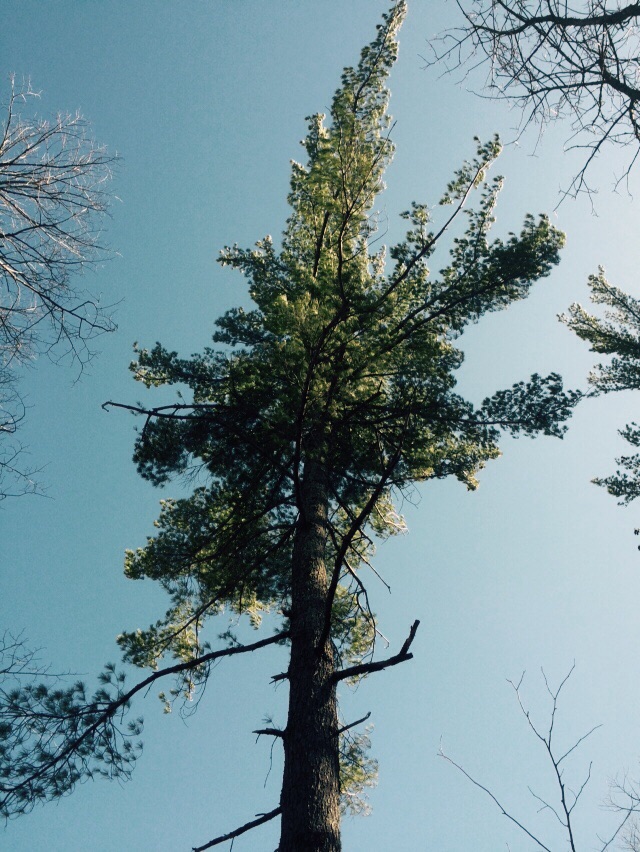


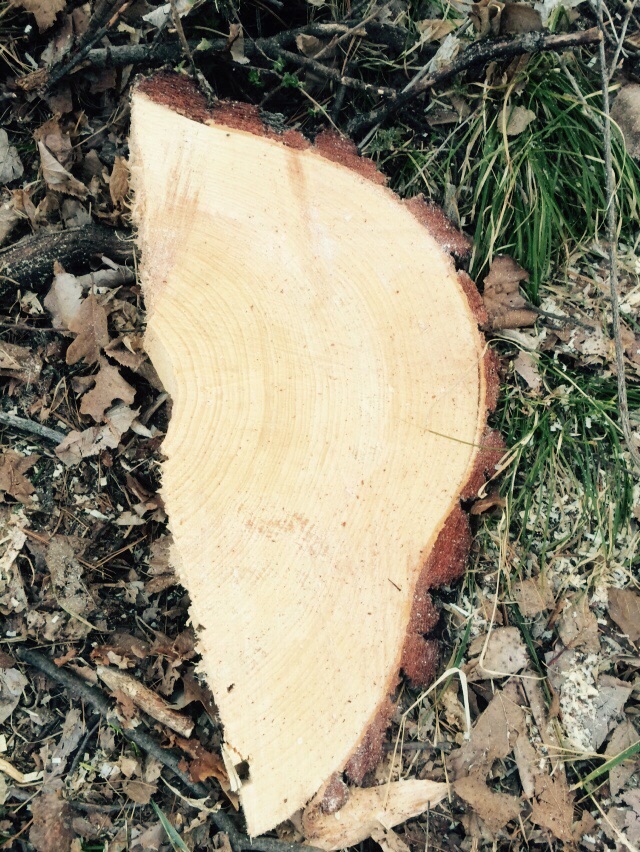
 everal days of work, the building site looks like a battlefield. I’ve learned a lot about felling trees and fixing chainsaws. So far, I’ve only had one near-miss in the category of getting clobbered by a falling tree, and that was one that got hung up in another tree. I’ve learned that happens a lot with basswoods and their large canopies.
 Finally, I have learned that I am not a logger. In the land where Paul Bunyan was born, Minnesota’s rich logging history is often romanticized. Although I’ve gotten somewhat proficient at the job, I have found no romance in the work. I don’t think I would have fit in among the men in the logging camps of yore. Call me a tree hugger, but I don’t like cutting down living trees. I think about the tons of carbon dioxide all that foliage processes. I could try to figure out the carbon footprint of our home, and determine whether the energy-efficient design offsets the biological impact. Or I could, and probably will, plant more trees to replace those I cut down.
 This is home.