Deer Camp

Grandpa Ray and Grandma Arleen made deer camp a very special experience for their grandsons. They passed on to us a hunting heritage that will, hopefully, continue in our family for years to come. Grandma was the “voman in the voods” as one old Norwegian who encountered her in the woods put it. Indeed, a woman hunting back in the 50s and 60s was almost unheard of. But Grandma was out there, along with her daughters – even when they were pregnant. Grandma was a crack shot and brought many deer down with her lever-action .32 Winchester. She was also a wonderful camp cook who had us looking forward to every meal.

Grandpa was just as excited as us kids to go to camp. He started preparing sometimes as early as September, shopping for the best bargain beer he could find. It had to be cheap because he bought a lot of it – 25 cases or more each year. That is a lot of beer but we usually could count on a lot of visitors to our camp deep in the Beltrami Island State Forest near Roseau. There were the Weber cousins who camped a few mile south of us, the Hoaglund crew who had a cabin nearby, the McCleods from back home, and others who would stop by our camp to inquire about our hunt and drink a beer or three. That is when the stories came out.

Deer camp stories, whether told around a campfire or around the table in the cook shack, were the highlight of every evening. The storytelling was always a raucous affair, the storyteller getting louder with every round of beer. It was as if we were making up for all the quiet stillness we practiced during our morning hunts. Sometimes that was practiced stealth, and sometimes it was just trying to avoid any loud noise because we were hung over from the previous evening’s festivities.

Beltrami camp

Grandpa Ray (lower right) and crew in camp, mid-1980s

While Grandpa loved a good party in camp, he was serious about getting as much venison as we could. He put as many if not more hours in the deer stand as any of us. Grandpa was especially focused when it came to conducting drives. Both the drivers and the standers were given explicit instructions. Whether we got a deer or not, we could count on an extensive postmortem from Grandpa on what went right or wrong.

Grandpa was also adamant that we get everything out of the deer we could. All the bragging we wanted to do about our latest kill was usually stopped short when he asked if we remembered to harvest the tongue, the liver and especially the heart. Per Grandpa, these delicacies were not to be wasted. Grandma often made pickled heart right in camp, and sometimes fried up fresh liver for dinner (both acquired tastes as far as I was concerned).

Grandpa liked securing some “camp meat” too. This usually involved cutting up a fawn or small doe and consuming it all during the week of camp. The way Grandpa saw it, nothing was better than fresh venison and there was no sense in wasting a tag on a small deer. That being said, Grandpa usually asked one of his sons-in-law secure the deer in an out-of-the-way place and butcher it there so as to avoid incriminating himself.

Occasionally, over after-dinner drinks, Grandpa would wax philosophical.  He talked about how lucky we were to be able to hunt, to have public land to hunt.  He talked about how public land was not available in many other states he had visited.  He thoroughly enjoyed being out in the woods in a make-shift shack on wheels, eating simple but hearty meals, and sharing the experience with family. He was right; we were very fortunate.

When I got my first full-time job after college, I made sure I saved enough vacation time to go to deer camp. We encountered tough hunting conditions that year and for this and other reasons we decided to pull camp early in the week. Grandpa felt bad I had taken all my vacation time, so he and I hunted around his place. Later in the week, we checked out a place in the White Earth State Forest that Grandpa used to lease from the county for grouse and duck hunting. I shot a forkhorn buck that day and eventually we found a new place for our camp for the following year.

Unbeknownst to me at the time, that next year was the last time I got to hunt with Grandpa in Minnesota. The following year my career took our family further west, too far to come home for hunting. It would be another 11 years before I would be back for the Minnesota deer season.

Now, almost 30 years later, we are still hunting from the same camp. My dad is now the Grand Old Man of deer camp and my mom is now the cook. I still hunt with my brothers and cousins and now, our kids, maintaining the traditions we learned from Grandpa Ray.

We just don’t drink as much beer.

Zhingwaak Revisited

IMG_0203We are fortunate to have a number of mature Eastern white pines (Pinus strobus), the tree the Ojibwe call zhingwaak, on our land. For me, the white pine symbolizes my love for this place called Minnesota. Tracing the silhouettes of pines at sunset on Island Lake as young boy, I first knew the joy of observing nature.  I’ve wanted to live among the pines ever since.

The white pine, along with its cousin the Norway or red pine (Pinus resinosa) attracted the first logging companies to Minnesota Territory back in the mid-1800s. Pine boards built thousands of homes, barns, storefronts, churches and schoolhouses throughout the Midwest.

Pine was in such demand during the settlement era that logging companies took every tree they could find, leaving barren landscapes wherever they went.  The greed of the timber barons provided impetus for the allotment acts that broke up the White Earth and Leech Lake reservations and allowed the taking of most of the land originally reserved for the Ojibwe by treaty.

Today, only remnants of these once-great pine forests can be found in scattered locations in northern Minnesota. Perhaps the most notable of these pine islands is the Lost Forty, located northwest of Grand Rapids.  A surveying mistake in 1882 resulted in the preservation of a small piece of Minnesota’s pre-settlement forest. (You can get a glimpse of the Lost Forty in this YouTube video: https://www.youtube.com/watch?v=lSBTlJGCitE)

The white pines on our land are probably “second-growth” trees that got established after the logging boom, which makes them at least 100 years old. They form a crown atop the knob we are building on, visible from across the lake and from the river outlet along Crown Point Road (I like to think the road is named after our little hill).

We reluctantly took down one of these majestic trees to make room for our house. We want to remember and honor this tree so we are incorporating as much of it as we can into our new home. After my friend Mike the DNR Forester felled the tree for us back in April, I hauled several of the logs to a local sawmill to have them sawn into 2.5-inch slabs which were then kiln-dried and planed. Last September, I picked up the sawn pieces from the mill and began making what will become “floating” shelves throughout the house.

IMG_0912

We are also having the top for our kitchen island made from these slabs. Athough it may not be practical to leave the bark on the island top, we’ll retain the natural shape of the edges.  Our fireplace will feature the slab on the far right of the above photo, bark and all, as the mantel.

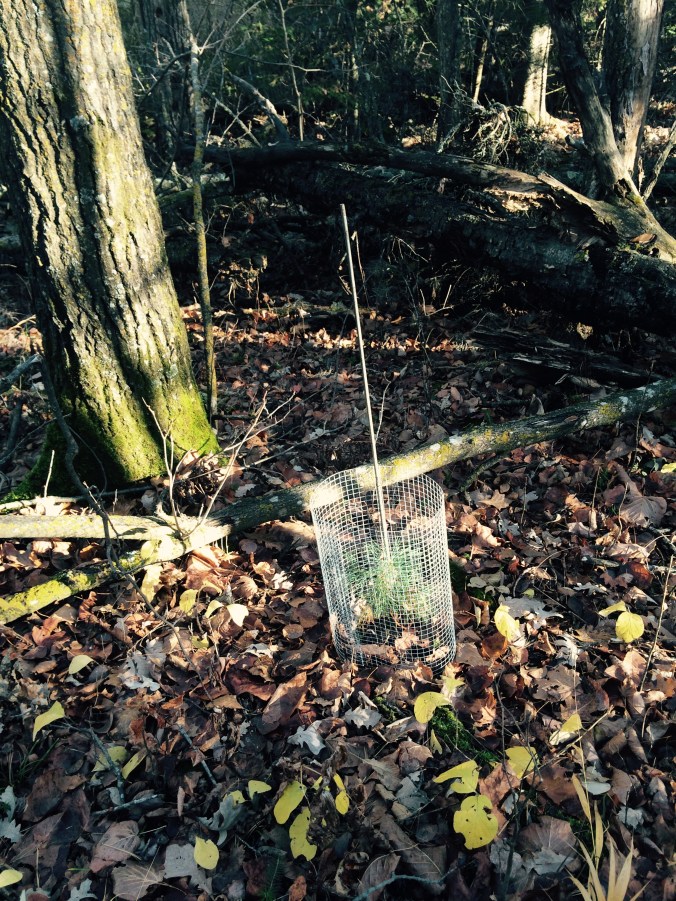
Meanwhile, as I poked around the woods this fall, I began to locate white pine seedlings coming up around our building site.

IMG_0952

To keep the deer from eating the terminal buds on these trees this winter, I erected little fences around each tree.

white pine

I’ll remove the fences in the spring to avoid inhibiting their growth.  Although Mel and I will be long gone when these trees become mature and add to the beauty of Crown Point, we hope our descendants and others will enjoy them for years to come.

A Visit to Sandy Lake

image

A few weeks ago, as Mel and I were returning from my nephew’s birthday party in northern Wisconsin, I suggested we make a side trip. We were in no hurry to get home, so Mel agreed.

“Where are we heading?” she asked.
“Sandy Lake; it’s near McGregor.”I replied.
“What’s there?”
“I don’t know – hopefully something telling about the history of the place.”

Instead of heading out of Duluth on Highway 2, we took Highway 210 to McGregor, then turned north. We saw no signs indicating any historical sites ahead but I thought there had to be something commemorating the place in Minnesota’s history. I got on my smart phone (Mel was driving) and googled Big Sandy Lake. Just as images of historical markers popped up, we happened by those very markers along Highway 65.

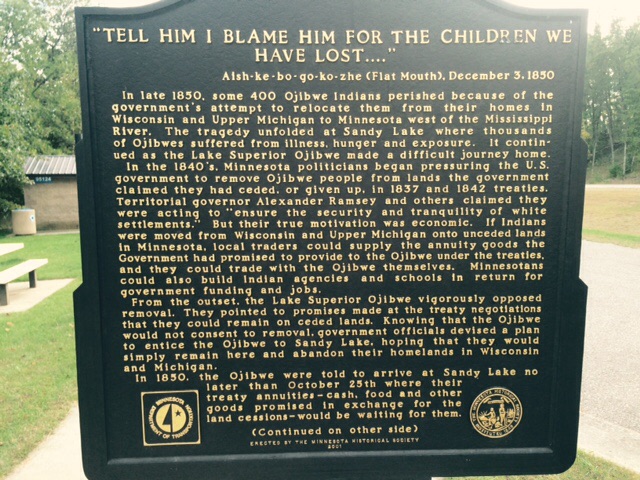
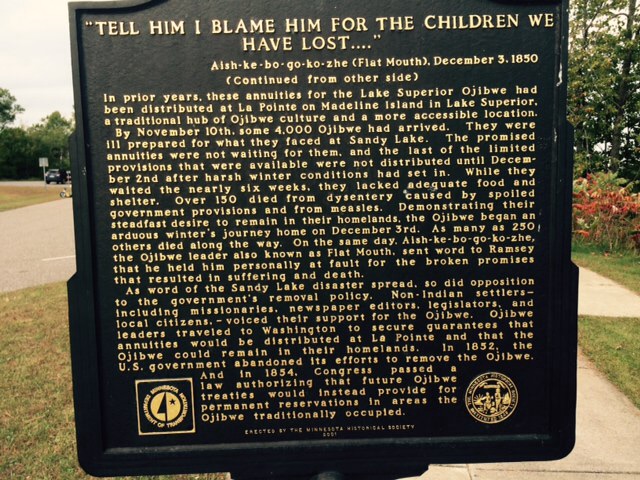
The markers are located at a wayside rest with a beautiful view of the lake. For some reason, the wayside rest was barricaded off, but we parked on the shoulder and walked in. I was surprised to find a detailed description of the Sandy Lake Tragedy that pulled no punches regarding the white leaders involved. The marker clearly describes the motives of Territorial Governor Alexander Ramsey and how the Ojibwe were wronged. High school history classes in Minnesota discuss Ramsey as a prominent figure in the state’s formation. I wonder whether his role in the Sandy Lake Tragedy is talked about in those history classes….

image           imageWe continued north toward the area where I read the old trading post was once located. Another surprise: a well-maintained recreational area at the outlet of the lake. The Corps of Engineers maintains a flood control dam at the outlet and has developed an attractive park, including more historical markers.

image The most recently installed marker, commemorating the Sandy Lake Tragedy, was established by descendants of the victims representing several Ojibwe tribes. Called the Mikwendaagooziwag Memorial, it stands on a small knoll that also is home to a very old cemetery.

image

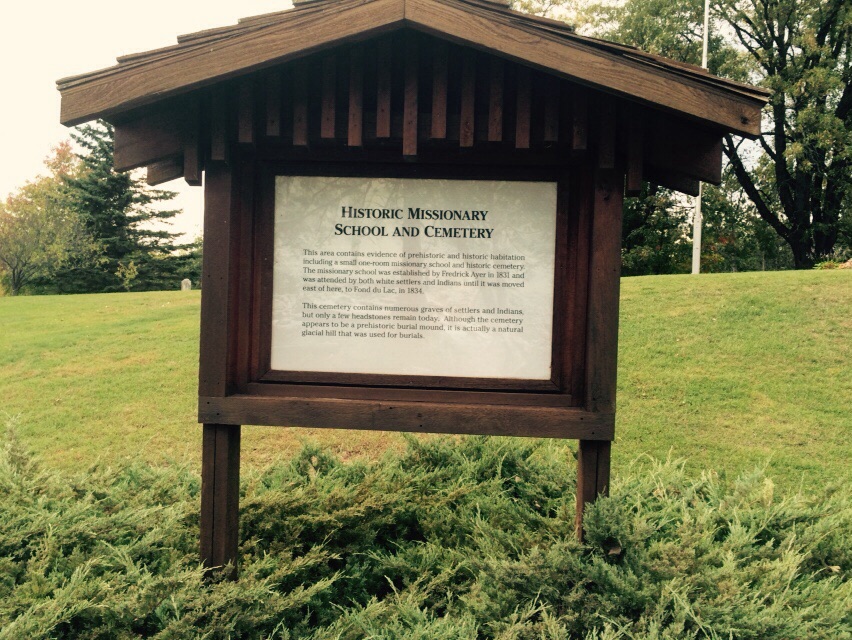
Based on the information on all the markers, it became clear that the main Ojibwe village was located here or very close nearby. The missionaries Frederick and Elizabeth Ayers established a mission here in 1831, and later moved it to Fond du Lac in 1834. Interestingly, the Ayers missionary life paralleled the journey of our family. Prior to Sandy Lake, the Ayers served at LaPointe, and they later appear in the 1849 territorial census somewhere north of Little Rock Lake, as the nearest neighbors to Antoine Blair. Whether there this is coincidence or there is a real connection between the Ayers and our family depends whether Alexander Blair was French Canadian or Scottish. If he was from Scotland, he would likely have been Presbyterian, like the Ayers. On the other hand if he was French Canadian and Catholic, he and his family would have had very little to do with the Protestant missionaries.

According to the historical marker on-site, the cemetery includes Indian and non-Indian graves. The marker clearly points out that, although the small hill resembles a burial mound, it is a naturally occurring glacial feature. Only two gravestones remain, both of which are dated in later settlement days. As I reflected on this information, it occurred to me that Alexander Blair and other members of our family may have been buried here.

image

Given its strategic location on the portage between the Mississippi and the St. Louis River and Lake Superior (Savannah Portage State Park is located near the lake’s northeast corner), one can imagine this area bustling during the height of the fur trade. Early American explorers, including Zebulon Pike, Stephen Long, William Cass and eventually Henry Rowe Schoolcraft, all stopped at Sandy Lake to rest and re-supply. The members of our family who lived here witnessed a very important era in Minnesota’s history. The same can be said for the family members who later settled at Watab, which will be the subject of my next post.

The Traveling Barn Door Finds a Home

Growing up on the Spry farmstead before the age of electronic entertainment, my siblings and I played a lot of ball in the yard. There was (and still is) a glacial erratic in the middle of the yard the top of which was exposed through the grass. This patch of rock made a perfect, permanent home plate. First base was a Norway pine sapling we planted when we first moved to the farm. Mom’s long-suffering snowball bush (a high-bush cranberry) served as second base, as well as a sideline marker for football games. Third base was usually a flattened cardboard box.

Our makeshift field was the setting for acting out our baseball fantasies, imagining we were in a major league park. We even had our own version of the Green Monster, the south side of the old barn, which officially measured 217 ft from home plate in left center. I painted that number on the barn in white paint, with large numbers and a smaller “ft”, just like the outfield fences in Met Stadium.

The barn hadn’t been used for its original purpose, milking cows, for decades. Inside, a few rusted stanchions hung from the beams. In the hay loft, several rotting horse collars were perched in the crooks of the rafters. For the first few years after we moved to the farm, Dad raised feeder pigs in the barn. My after-school chores included “slopping the hogs”. After the pigs were gone, the barn sat empty again.

When my siblings and I returned to the farm on annual summer visits as young adults, we noticed the old barn was nearing its end. Each year, the sides of the ground floor leaned further north, as the classic barn roof with its aluminum cupola, still stately but sagging a bit in the middle, slowly sank to the earth.

On one summer visit some 20 years ago, Mel and I learned the Callaway Volunteer Fire Department was scheduled to use the barn for practice. We salvaged two doors from the barn, the main door from the front and a side door near the silo. We were visiting from our home in Montana at the time and hauled the doors all the way back on the roof of our Jeep Cherokee. We had no idea what we were going to do with them, but we thought they were cool and reminded us of home.

The larger door. The nicks and gouges in the middle are from the steel fencepost we used to prop the door shut on the barn.

The larger door. The nicks and gouges in the middle are from the steel fencepost we used to prop the door shut on the barn.

From Montana, the doors moved with us to Idaho, from there to New Mexico, and finally back to Minnesota when we bought our cabin on 5th Crow Wing Lake. We used the smaller door as a headboard for a while and the larger one to display antique fishing lures but mostly they stayed in the garage and collected dust. Although we spent thousands of dollars renovating and redecorating every house we owned, we never permanently installed the doors in any house. We knew we’d be moving on at some point and didn’t want to leave them behind.

When we started designing our house last winter, we spent a lot of time looking at the Houzz website (or what we call house porn), for ideas. We learned about the latest decorating craze: barn doors. These are doors that slide along a track and look old, for which you can find hardware on at least a dozen sites on-line. You can even order doors made from reclaimed wood. Designers have learned what we have known for years: old barn doors are cool.

Finally, we had a perfect opportunity to incorporate the doors into our “forever” home. There was one problem: neither door was large enough to cover a standard opening for an interior door. So I bought some pine boards and built a frame that incorporates the large door and is big enough to cover the door opening. The barn door was lop-sided, missing parts and no longer square but I made no attempt to fix any of that. I took the old door apart and inserted some old galvanized steel Mel had salvaged from her grandpa’s farm.

The completed project.

The completed project.

The back side of the frame.

The back side of the frame.

Hardware installed.

Hardware installed.

The finished project awaits installation between my office and the master bedroom after interior work is completed on the new house. We’re still not sure how to use the other barn door, which is smaller yet. It will stay in the garage, collecting dust until inspiration strikes again.

On the Farm, Part 2

NOTE: After I wrote the previous piece about working with my Grandpa Ray and Great-grandpa Alfred on the farm, I asked my Grandma Arleen why Grandpa seemed so unhappy as a farmer. She told me about the long, tempestuous history of father and son farming together. I retell the story here, first starting with some background.

Herman Alfred Faltersack was born in 1899 to Oler and Kate (Temple) Faltersack in Columbus, Wisconsin. The family, who were farmers, had moved to the Faribault area in Minnesota by 1910, and eventually settled in Iosco Township in Waseca County. Alfred, as he was known, married Alma Grob of Waterville in 1919. The 1920 census found them on a rented farm and the proud parents of a son, Raymond Arthur. As the family story goes, Raymond was laid in a basket perched on the open door of the oven to keep him warm.

Although farm machinery was becoming more available, farming in those days was mostly manual labor and working with teams of horses. In addition to strong backs, farmers in those days had to have strong wills to survive. Farms were typically very small, especially by today’s standards, producing nearly all the food the family needed, and in good years, income for clothing and other necessities. In those days, farmers did not have price supports and other government programs to fall back on. Every spring planting was a new gamble. Many farmers failed and they and their families moved on to cities to find work or to new land to try again. A farmer who could stay on his land – make the bank payments – and feed his family was considered successful. Staying on the land was a source of pride.

Alfred and Almie, as she was known, farmed all their lives. According to the 1920 and 1930 censuses, they rented their farm. Their landlord was probably Alfred’s father Oler. Oler and Kate lived next door in 1920; by 1930, they had retired and moved to Elysian. The 1940 census also indicates that Alfred and Almie were renting farmland, although they owned their home. After Oler’s death in 1945 Alfred continued to rent from his mother Kate. It is unclear whether Alfred and Almie could not quite afford to buy the farm, or Kate didn’t want to sell. Regardless, Alfred was likely frustrated, maybe even humiliated by the situation.

Raymond and his sister Mary grew up on the farm with most of the extended Faltersack family living in the area. Sometimes, one or more of their cousins came to live with them when trouble was brewing in their own homes. Many of the Faltersacks were hard drinkers, and their children suffered the consequences.

All the Faltersack children did farm work from an early age. Each child was expected to pull their own weight. Ray milked the cows, cultivated the fields and worked with the threshing crews during harvest time. They grew up during the Great Depression, and made money whenever and wherever they could. During Prohibition, Ray collected bottles along the railroad tracks to sell to bootleggers. He also caught and sold bullheads for a nickel a bushel.

Grandpa Ray told me a story from Prohibition days involving a picnic and home-brewed beer. When they were about 12 years old, Ray and a friend spied some bottles of beer in the back of an old Stanley Steamer at a picnic. When no one was looking, they snuck up to the car, swiped as many bottles as the could, and ran down into a ravine to drink them. Being their first experience with home brew, they did not know to avoid drinking the yeast in the bottles. Grandpa said they got “sicker than hell.”

Ray had a cousin named Ione who had a friend named Arleen Hawthorne. Ione and Arleen did everything together, including climbing on top of parked car to watch the fireworks one Fourth of July. As they were oohing and ahhing, the cloth roof of the car gave way under their weight and they found themselves in the back seat laughing hysterically. Grandma said they bailed out of the car and ran away before the owner returned.

Ray and Arleen began dating in their early teens. When Ray was 20 and Arleen just 17, they decided to get married. He being Catholic and she being Lutheran, there was little chance of their families approving the union. So the lovebirds eloped. Ray cashed in his life insurance policy, took Alfred’s Model A and drove Arleen to Iowa where they were married by a Justice of the Peace. On returning to the farm, the new bride was met at the door by Almie, who asked Arleen if she was pregnant. Arleen replied “no” and Almie said “welcome to the family.”

Ray and Arleen lived with Alfred and Almie in the early years of their marriage, helping with the farm. Ray also worked off the farm, mowing peas for a local cannery. When World War II broke out, Ray’s draft status was II-C, a deferment for men “necessary for farm labor.” Throughout the war, Ray was required to check at the courthouse regularly to see if his draft status changed. Several of his cousins as well as Arleen’s brother Dewey served. The Faltersack farm was where they gathered when on leave.

After the war, Ray continued to work with Alfred on the farm. Increasingly, they became at odds over farm operations. Other conflicts involving Grandma Kate and Alfred’s siblings also added to the tension. Grandma Arleen recalls one argument ending when Ray told his Dad “sell the damn cows, I don’t care.” So Alfred did. This left Ray and Arleen without a future.

After deciding they needed to move on, Ray and Arleen held an auction on the farm. The extended family attempted to interfere with the auction by getting the sheriff involved. Ray had some pending legal troubles after an altercation with his brother-in-law, who was abusive to Ray’s sister Mary. The brother-in-law, with help from one of Ray’s uncles, insisted the sheriff shut down the sale and arrest Ray. Ray’s cousins intervened and convinced the sheriff to let the sale proceed. Ray eventually paid a fine for beating up his brother-in-law.

The young couple headed north in 1948, leaving Waseca County and their troublesome relatives behind. While looking for a place to start over, they stopped at a little beer joint called the Cozy Coach in Westbury, a remnant of a town located north of Detroit Lakes. The Coach was a converted railroad car that featured a bar as well as a few groceries and a gas pump out front. A house connected to the back of the Coach served as a residence. After a few beers, the owner, Henry Katzenberger, convinced the couple to buy the Cozy Coach.

Operation of the business fell largely to Arleen, as Ray was busy launching his custom baling service. He had noted on earlier trips up north that farmers in the area were still harvesting hay by stacking, a method that orignated centuries ago. Ray was familiar with a brand new technology, the hay baler, and soon was baling hay from one end of Becker County to the other and beyond. Ray and Arleen and their three kids were prospering.

A few years later, Alfred and Almie moved north. Alfred, then in his 50s, bought a 160-acre farm a half-mile west of Westbury. Soon it became evident that Alfred needed help on the farm. He needed Ray. So Ray reluctantly became Alfred’s farming partner again.

Soon, the old tensions between the two men resurfaced.  The father’s pride was tied being a successful farmer. The son’s loyalty was tested again.

Knowing all this history, thanks to Grandma Arleen, gives me a better understanding of Grandpa Ray and his relationship with his “Pa”. Grandpa Ray didn’t want to be a farmer.

Uncle Antoine

“On the shore of Little Rock Lake lived several families of French-Indian breeds. The had a few scrub ponies, cows and pigs.  The lived in log huts and farmed small tracts.  They hunted, fished, trapped and did nothing.   One breed was named Steve Baillou and another Antoine Blais, which became pronounced Steve Blue and Tony Blair by the neighbors.” – from notes of Nelson and Robert Flint, included in A Land Called Morrison, by Harold Fisher

Antoine Blair, one of the younger brothers of Angeline (Blair) Trotterchaud, had been living in the area since at least 1849.  The territorial census of that year listed him at 21 years of age and living in the “Sauk Rapids District” of “Benton Territory.” (Apparently, Benton County was not officially a county yet.)  Also counted in Antoine’s household were Charlotte, age 16 and Josette, age 4 months. Antoine’s occupation was listed as “none”.

In 1849, year Minnesota became a territory, less than 6000 non-Indians lived here, and only a few hundred lived north of St. Paul. Reading the census data, it appears that the nearest white people in the area were the missionaries Frederick and Elizabeth Ayer, who had established a mission and farm at Belle Prairie, some 20 miles up the Mississippi, in 1848. (Belle Prairie is the area where the Bellefuielle family first settled in the 1850s.)

In that same year an American Fur Company employee named David Gilman moved to the area and purchased a trading post established the previous year by Asa White. Another trading post was established by William Aitken just two miles north.  The place was called Watab, and was located near the mouth of a river by that name that emptied into the Mississippi.  Antoine may have been employed by Aitken or Gilman or at least traded with them.  Trading was done with a large Ojibwe village located near the outlet of Little Rock Lake. From 1848 to 1855, trade was also conducted with the Winnebago tribe, whose members were relocated to the area from Iowa for that brief period in a move orchestrated by businessman and trader Edmund Rice. This scheme was intended to open lands for settlement in Iowa while establishing the Winnebago as a buffer between the Ojibwe and their Dakota (Sioux) enemies.

Watab was also located along the Red River Oxcart Trail as it followed the Mississippi south to St. Paul.  The oxcart trail system was developed by Norman Kittson a few years before to facilitate trade between St. Paul and settlements on the Red River north of Pembina. The mostly Metis oxcart drivers, who were independent contractors, tended to carry cash, which drew the interest of the traders and other merchants who started settling the area.

In 1857,  according to General Land Office records Antoine obtained the deed to some 37 acres located along the west shore of Little Rock Lake, near present-day Rice, Minnesota. The Preemption Act of 1841 permitted “squatters” who were living on federal government owned land to purchase up to 160 acres at a very low price (not less than $1.25 per acre) before the land was to be offered for sale to the general public. To qualify under the law, the “squatter” had to be:

a “head of household”;
a single man over 21, or a widow;
a citizen of the United States (or an immigrant intending to become naturalized); and
a resident of the claimed land for a minimum of 14 months (Wikipedia).

The 1860 census recorded Antoine’s occupation as “Farmer”, which was typically used for homesteaders. However, the 1870 census lists him as a “Livestock Raiser”.  This suggests that Antoine, as well as one of his younger brothers listed the same way in the census, developed a business raising and selling draft animals.  These likely included oxen that were sold to the drivers on the oxcart trail.

The 1860 census indicates Antoine had five children, ranging from 2 to 9 years old, including Josette.  However, Charlotte is not listed. Another woman named “Gebel”, age 30 is listed. The name is a misspelling of Isabelle. According to Ancestry.com, her Indian name was Quanzee. It appears that Charlotte had passed away sometime in the previous 11 years.

Antoine and “Belle” raised their family at Little Rock Lake and apparently prospered there. I had the opportunity while doing research at the Benton County Historical Society to review papers associated with the disposition of Antoine’s property and settlement of his debts. David Gilman served as the executor until his death in 1885. The process was finalized by a man named Campbell. The file included dozens of slips of paper with transactions recorded in pencil. Antoine appeared to have good credit, as he did business throughout the area from Little Falls to Elk River.

My hunch is his success played a role in convincing Peter and Angeline Trotterchaud to move their young family there.  Peter purchased his land claim consisting of 39 acres next door to Antoine’s homestead in 1856.  (More to follow on the Trotterchauds in later posts) When Peter and Angeline and several of the Blairs moved to White Earth under the terms of the 1867 Treaty, Antoine and his family stayed behind.  Apparently, he was doing well enough that the prospect of receiving 160 acres of land and a fresh start did not appeal to him.

Antoine died in 1883 when he was crushed by an ox. According to his death certificate, the cause of death was falling off a wagon.  But according to Mary Ostby, Executive Director of the Benton County Historical Society, it was common to avoid blaming an ox for the death, as it would make the animal difficult to sell. Antoine’s death was noticed in the Sauk Rapids Sentinel, which noted “Tony” was well known in the area.  Even though he was a “French breed” who “did nothing,” he had earned at least some respect in his community.

Our Mysterious New Neighbors

Below our homesite, the lake is quite shallow (2 to 3 ft deep) and full of lily pads, which essentially precludes docking a boat or pontoon. That is fine with Mel and me; we would like to keep the shoreline undeveloped. However, I thought it would be nice to have a footpath from the house down to the shoreline. All this path required was moving a deadfall or two and trimming a few low-hanging branches.

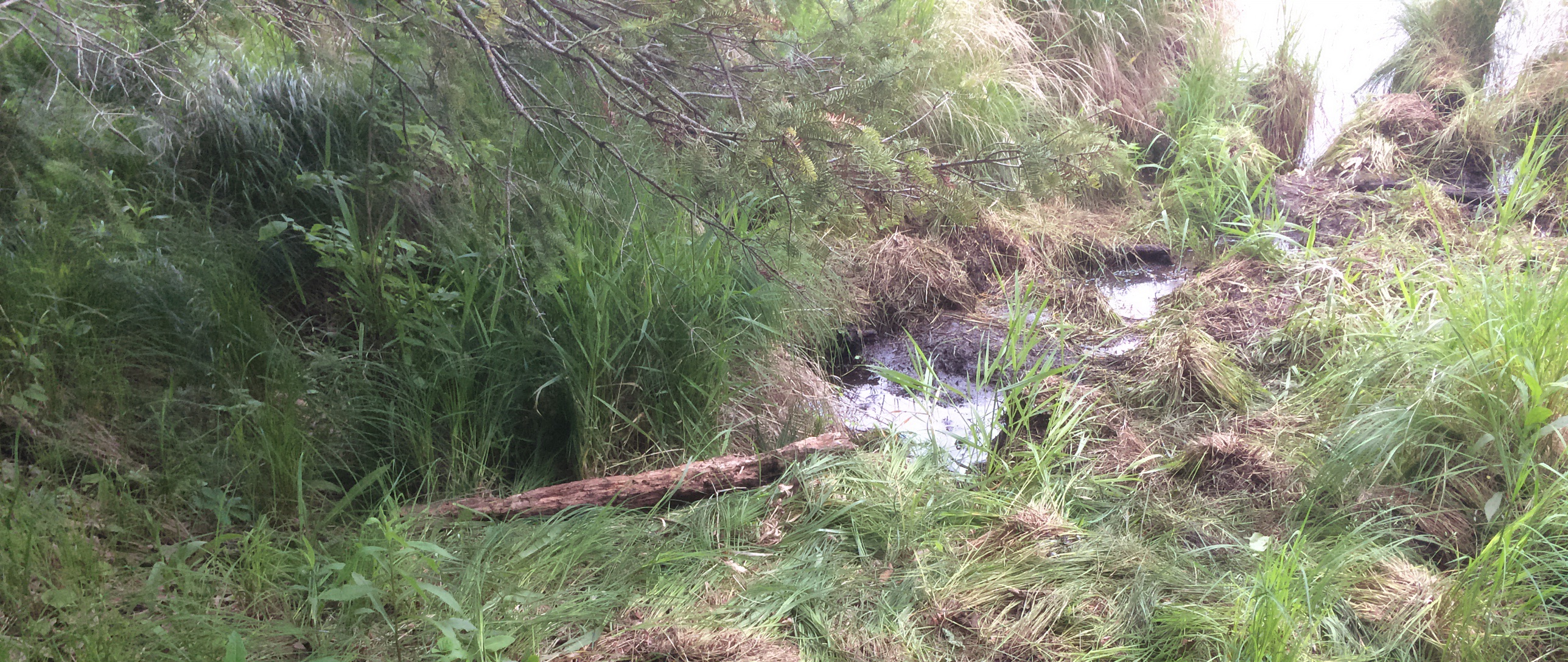
One day in June, while working on this project, I came across a strange scene. In an area about the size of a dining room table adjacent to the waterline, all the grass had been flattened. My first thought was that a bear had been lounging around, maybe gnawing on a dead fish. As I looked closer I found scat, but it didn’t look like something that came out of the backside of a bear. The stools were smaller than standard bear poop and were full of bits of shell and fish scales.image

image

Ok, maybe not a bear, but a racoon, I thought. But why would racoons flatten all this grass? As I pondered this I glanced up the slope and noticed more grass flattened and what looked like an anthill that had been leveled. Again, it could have been a bear searching for some 6-legged appetizers. But there were no claw marks indicating digging.  Instead, the dirt looked smoothed out, like something had been sliding on it. That’s when I got excited – this could be river otter sign.

image

Otters are my favorite animal. If I had to choose an animal form for the next life, it would be the otter. My kids know I have a thing for otters; Emily even sculpted one out of soapstone for me.

The first time I saw otters in the wild I was deer hunting with my dad, about 20 years ago. I was standing on the edge of a clear cut, waiting for Dad to work his way across. The sun had set, so it was nearing the end of the hunting day. While watching Dad pick his way across the stumps and brush, I heard splashing behind me. There, in a pond about 75 yards away, were two otters playing. They were silhouetted in the orange dusk. Dad and I watched them for several minutes until it finally grew too dark to see them and then we headed back to camp. This is a favorite memory for me.

We have seen muskrats and beavers swimming along our shoreline, and even had a tree cut down in our yard by a beaver, but we had never seen otters. How cool would it be to have otters living next door? Having a bear in the neighborhood would be less cool.  If they are otters, we would be lucky to actually see them. Although they are playful and seem gregarious, they are quite shy.

Maybe one of my thoughtful children will get me one of those trail cameras for Christmas…

On the Farm, Part 1

Grandpa owned a small grain farm in partnership with his ‘Pa’, Great-grandpa Alfred. The farm, just 160 acres, consisted of several hillocks with wetlands winding between them. It was located about a half-mile west of Westbury where my mom grew up and about 4 miles north of Grandpa and Grandma’s place on Cozy Cove Road. The soil at the farm was rocky and pretty thin on the hilltops. The farm never made much money, but it provided an income for Great-grandpa and Great-grandma Almie to supplement Social Security. Looking back now, I don’t think Grandpa Ray wanted to be farming, but kept the operation going for the sake of his parents. Farming was all they knew, and the old farmhouse was their home.

I started working on the farm when I was about 10, mostly picking rock, running for tools or parts, and helping feed Great-grandpa’s hogs. Grandpa Ray taught me how to do basic maintenance on the equipment, like greasing the myriad pulleys on the combine, replacing shear pins on the cultivator and pumping up tires. As I grew older, I learned how to operate the equipment.

I took a lot of pride in being able to hook up the plow or cultivator and head out to a field to work on my own. I usually drove Grandpa’s John Deere 720 Diesel, the biggest tractor on the place. We had another older John Deere, a Model ‘A’ that was Great-grandpa’s favorite. He taught me how to start it by turning the flywheel. Great-grandpa seemed to look younger and stronger when he sat on that tractor.

Grandpa Ray’s favorite seemed to be the Allis Chalmers WD with the narrow front. It was the one tractor he never taught me to drive. I was a little scared of it, remembering the story Grandpa told me about my uncle Tom breaking his arm trying to start it with the hand-crank in front.

The WD was Grandpa’s go-to tractor for particular jobs, like harrowing, seeding and raking hay. The latter chore was fascinating to watch. Grandpa would pull the rake in high gear at full throttle, creating windrows on the fly. The rake itself was an almost fanciful contraption, with large wheels full of tines mounted at an angle and spinning rapidly. The WD could turn on a dime, and Grandpa was expert at the maneuvers needed to create windrows of the proper spacing and volume for baling. Watching him rake a field of alfalfa on a late summer evening was like watching a ballet.

One of my favorite memories from the farm is how much I enjoyed Great-grandma Almie’s cooking.  By how much I mean I ate a lot of it!  We started out very early each morning with coffee and homemade cookies or banana bread and then went out and got the machinery ready to go. Then we came back in for breakfast, which was usually ham and eggs and coffee and pancakes and more coffee.  Sometimes we came back in for a coffee break mid-morning and ate more baked goodies. Lunch was another big meal, after which Grandpa Ray would take a nap.  After at least one more coffee break in the afternoon, we worked late and came in for supper, somehow hungry for more.  Great-grandma cooked for threshing crews when she was younger so she knew how to make good, rib-sticking food and lots of it.

I enjoyed working on the farm, except at harvest time. Grandpa planted at least half the acreage in barley every year. Unlike wheat, heads of barley have a heavy beard, which becomes a cloud of itchy chaff as it is combined. Early on, the farm had a combine that was pulled by a tractor. Later, Grandpa bought a self-propelled combine, which I considered to be the height of farming technology, even though it did not have an enclosed cab. I rode the combine with Grandpa until I was old enough to operate it myself.

Harvesting barley was the dirtiest and itchiest job in the world. Perched above the noisy “pickup”, a short, wide conveyor that pulled the windrows into the combine for threshing, the operator was smack in the middle of the dust cloud billowing up. To make matters worse, we always harvested during the dog days of August, with temperatures above 90 before noon. Sweat made the dirt and chaff stick to the skin. Like most boys entering puberty, I was probably reluctant to start showering. But nothing felt better than a hot shower after a day of riding the combine.

Another dirty job was shoveling grain into bins. The farm did not have any of the shiny grain bins the bigger farms had. Instead, we built make-shift bins in unused areas of the barn and in the old feed shed. Some grain was also stored on Grandpa’s place using old farm buildings the same way. The bins consisted of old boards nailed up to enclose doorways and form up sides. Because these were usually odd-shaped configurations and the roof was low, my job was to climb into the bin and shovel the grain into the corners and level it out as it came out of the auger. This meant trying to shovel while knee-deep or on my knees, breathing hot air full of dust in the mostly enclosed bin until the load was emptied or the bin was full. Grandpa always kept an eye on me in case the heat and dust got to be too much, but I hung in there until the job was done.

Harvest time seemed more fun when I was younger. I can remember riding to the grain elevator in Callaway with Great-grandpa in the “grain truck.” A ’42 Ford one-ton with a hydraulic lift and a wooden grain box, the truck seemed as ancient as Great-grandpa. And like Great-grandpa, the truck smelled of Copenhagen snuff. He always had a pinch in his cheek, and spat through the hole in the floor boards of the old truck. Other times I rode with Grandma, who drove the pickup with boards mounted on the sides of the box. If I was lucky, I got a bottle of pop while the elevator man dumped the load through the grated floor. I loved to watch Lyle, the manager, work the grain sorter that helped him calculate dockage for weed seed and debris. But we didn’t dawdle – we had to get back to the farm right away so Grandpa wouldn’t yell at us.

Grandpa wasn’t as much fun to be around on the farm compared to when we were out on the lake. Between the equipment breakdowns and bad weather, getting everything done was always stressful for him. He yelled a lot. He yelled at Grandma, he yelled at Great-grandpa, and he yelled at me. I did a lot of things wrong, and sometimes Grandpa would get upset, but for the most part he was patient with me. He wanted me to learn.

What usually got me in trouble was not paying attention. I was a daydreamer, staring off into space thinking about who knows what while Grandpa was yelling for a 5/8″ socket. More than once I incurred his wrath while sitting on the tractor in a reverie as he was frantically waving from the overfull combine for me to bring the gravity wagon. Sometimes I would forget to follow through on an assignment he gave me and then I would “catch hell.” Fortunately, Grandpa didn’t stay mad at me for long, and he would patiently put me back to work.

Recently, I asked Grandma Arleen why Grandpa didn’t seem to like farming. She told me a story about farming in earlier days.  The events in that story shaped our family’s future.  The story also gave me a better understanding of Grandpa.  I’ll share that story soon.

The Best Laid Plans….

Mel and I have long agreed that one of the “must haves” in our new house was a screen porch. We saw the porch as the best way to enjoy summer evenings in the woods: watching the sun set over the lake, listening to the loons and enjoying friends and family all without having to swat mosquitoes.

When we began designing the house our emphasis on a passive solar design required that the porch be located on the end of the house to maximize the number of south-facing windows. Having the porch on the southwest end made the most sense, since it was closest to the lake and would have the best view. We anticipated that we would be cutting into the ridge on the west side of the house to create a level surface for building. We thought this would mean the porch would have a 3- or 4-ft berm against it, but believed there would still be room for a view.

By the time excavation was completed and the foundation was in place, it was clear that we had underestimated the depth of the cut on the west end of the house. What we thought would be a 4-ft cut became a 7-ft cut. To get any kind of view out the porch would require excavating out the south toe of the ridge, which lies within the 100-ft shoreline buffer zone. After obtaining a variance, our excavation contractor had already taken some of this material out, which created a nice level space for a patio in front of the living and dining rooms. But to get the view we wanted from the porch would have required taking out a lot more material, doubling the size of the disturbance in the buffer zone.

image

The screen porch was to go in this corner. (Buddy included for scale)

Meanwhile, Mel was lamenting the size of her sewing room and spare bedroom. As an unintended result of making revisions to the plans previously, this room became less than 11 ft wide. This worked against our original intention of having a spacious, handicapped-accessible spare room. After contemplating these issues while staring at the ceiling one sleepless night, I came up with a solution to both problems. We would eliminate the screen porch, move the TV room (which doesn’t need a lot of windows) into that space and expand the sewing room and spare bedroom. We ran the idea by Bernie, our contractor, who had also been scratching his head about the porch. He thinks the change makes sense.

Giving up the screen porch is hard. We’ll have to put up with the bugs if we want to sit outside in the evenings. More than that, it means giving up a fun, comfortable space in which to entertain and relax. But the space would only have been used 3 or 4 months out of the year, which doesn’t sit well with our practical mindset. We’re at peace with this change; we get a little more space where we need it and we won’t have to break more ground. Someday maybe we’ll build a screen gazebo. Meanwhile, we’ll just use more bug spray.

Out of the Woods

Following their marriage at La Pointe in 1843, the next data point I found for Pierre and Angeline Trotochaud is July 27, 1848. On this day, Pierre declared his intention to become a U.S. citizen before a county clerk in St. Croix County, Wisconsin Territory. This would have been in Stillwater, in what is now Minnesota. Later that year Wisconsin became a state. The following year, 1849, Minnesota Territory was formed from the areas left over after Wisconsin and Iowa (1846) statehood.

I came across this information in a book titled “Declarations of Intention (1847-1852) of 262 Minnesota Pioneers”, published by the Minnesota Historical Society. The author, James E. Erickson stumbled upon an index of the first declarations made in St. Croix County and was able to track down the actual hand-written declarations for all but 3 of the 262 pioneers. Unfortunately, Pierre’s declaration, which would have stated where he entered the U.S., is one of the missing three.

Stillwater was ground zero for the beginning of Minnesota’s logging boom. One can imagine how shocking it must have been for the young couple to come from Sandy Lake (or LaPointe or Fond du Lac or Lac du Flambeau), deep in the woods, to this boomtown with all its hustle and bustle.

They may have come to Stillwater looking for work, or they may have just been passing through. Regardless, they were leaving behind the life they knew. The fur trade was winding down, transitioning from large monopolies like the American Fur Company controlling vast territory to independent traders focusing on particular locations still holding furs. Working for these independents probably was not as stable as working for the old “outfits”.

Meanwhile, their Ojibwe relatives were finding the subsistence lifestyle more difficult to maintain. A succession of treaties the Ojibwes were making with the federal government continued to reduce their land base, making them dependent on government food supplies.

These were the circumstances that set the stage for the Sandy Lake Tragedy in 1850. Territorial officials, led by Alexander Ramsey, sought to remove the Ojibwe from Wisconsin. To do so, they moved the location of the annuity payments under the treaty from LaPointe to Sandy Lake. Thousands of Ojibwe made the trek to Sandy Lake, only to find the annuity payment had been delayed. Government food supplies were late in coming, and what food was available was spoiled, which eventually sickened and killed hundreds. Lobbying by Ojibwe chiefs and public pressure finally forced the government to allow the people to return to their homelands. But by then winter had set in, and many more died on the way.

It is not clear whether any of Pierre and Angeline’s extended family were still at Sandy Lake to witness the tragedy. Her brother Antoine had settled on land near Little Rock Lake, near present-day Rice, Minnesota in 1849. It is possible that Margaret Blair (Ma Chay) and the younger siblings stayed at Sandy Lake, among her relatives. As for Pierre and Angeline, the 1849 census (and the 1850 census) found them in Little Canada.

Founded just 5 years before by Benjamin Gervais, Little Canada, as the name implies, was originally a town full of French Canadians. Gervais had arrived in the area as a refugee from the Red River colonies in 1826, and was twice forced off Ft. Snelling land by the U.S. Army. Gervais had Dakota Indian friends who told him about the rich land of their traditional summer camp at “Lac du Savage.” After scouting the area, he sold the 160 acres he had purchased from “Pigs Eye” Parrant (property which would later become downtown St. Paul) and moved to the lake that now bears his name. By 1850, about 30 families had moved to Little Canada.

Some twenty years ago, when I first became interested in our family history, I came across a record that indicated Amelia Trotochaud had been born in “New Canada” in 1851 (of course, now I can’t remember the source or where I found it). Assuming this refers to Little Canada, it would make Amelia one of the first babies baptized in the St. Paul Diocese, founded in 1850.

In my research, I’ve found several sources of information on the early days of St. Paul and Little Canada. Each source takes great pains to individually name each of the families that arrived and the year of their arrival. J. Fletcher Williams’ “A History of St. Paul to 1875,” first published in 1876, focuses on the prominent businessmen and other early leaders, apparently very few of which were French Canadian. The French Canadians are given better treatment in “Minnesota Territorial Census 1850”, (Minnesota Historical Society 1972), which provides additional information on the families found in that census. Henry Scholberg’s “Les Pionneers Francais du Minnesota” names dozens of families that settled in Little Canada, including 14 French Canadians who arrived at Little Canada in 1849-50.

Interestingly, the name Trotochaud does not appear in any of these publications. How is it possible that Pierre and Angeline’s family were overlooked? I have a theory. In those days, people like Angeline were considered “half-breeds”, people who lived like (and sometimes with) Indians. Largely illiterate and non-English speaking, they were ostracized by mainstream society. As I will discuss further in my next installment, mixed bloods such as our ancestors were largely ignored by whites. To put it another way, while “half-breeds” were officially counted in the early censuses, when it came to early Minnesota historians, they didn’t count.