He Painted It Silver

Grandpa was a creative guy in his own way. His creativity came out of his experience growing up on a farm during the Great Depression. He learned to make do with what he had on hand, to fix things whether he knew how or not and to make use of every scrap of useful material.

Grandpa’s choice of media was scrap metal. He did not make abstract sculptures, although sometimes the odds and ends I found around his shop approached art. He made practical things, usually inspired by an ad or story he saw about some new gadget. For example, he made his own wall-mounted can crusher when recycling aluminum cans caught on. When the Club was advertised as the answer to auto thefts, he built his own version.  His “Club” consisted of angle iron and iron pipe welded together in a configuration that could be padlocked. Although I do not remember exactly how it worked, I do recall that part of his device was permanently bolted to the dash of his pickup truck. The finishing touch: a couple coats of silver spray paint.

The silver spray paint was Grandpa’s signature. He used it to cover up scorch marks and welds and to give his contraptions a shiny, new appearance. I suppose he thought it approximated the look of chrome. But the silver paint did not hide the fact that the object was homemade. That was made clear by the cutting torch edges, rough grinder marks and odd holes or bends from whatever use the scrap had in a previous life.  Anyway, appearance was not that important to him; what mattered was the device worked.

Grandpa was all about solving problems. When he and Grandma began traveling to Texas in the winter, they had to pack as much stuff as they could in their 4-door sedan. Of course, when one fills the trunk for a long trip one hopes they do not have a flat tire. No one likes to unload their car on the side of the road to get at the spare. Grandpa came up with a workaround to this problem. He would take the spare “donut” tire out of its place in the trunk, fill that space with stuff, and then bolt the spare to the top of the trunk lid.  When he first tried this concept he had an older car and probably did not diminish its value much. But a few years later he bought a brand new car – and immediately mounted the spare on top of the trunk. My dad called it “Ray’s Lincoln Continental Kit.”

When I was in grad school in Bozeman, Montana, my grandparents came to visit and meet their first great-grandson. Grandpa and I tried our hand at trout fishing on the Gallatin River, even though we were not particularly fond of eating trout.  We talked about trying them smoked, but did not have a smoker. The next time they came out, Grandpa brought me his latest creation: a contraption that would convert our little Weber grill into a fish smoker.

The device consists of a cut-off 30-gallon steel barrel with a rod welded across the middle. On this rod is balanced a piece of grill cut and welded to fit in the barrel. Attached to the welded grill are two racks that support the second grill, which is the one that came with the Weber. To smoke fish, one lights a charcoal fire and dumps wood chips on it to create smoke. Grandpa said it took about 8 hours to completely smoke a batch of fish. I have hauled it around through 6 states over the last 30 years , but never got around to using it.

Not sure I ever will use it, but I will always keep it. After all, Grandpa made it for me.

Maybe I’ll paint it silver.
 

After the Storm

OLYMPUS DIGITAL CAMERA

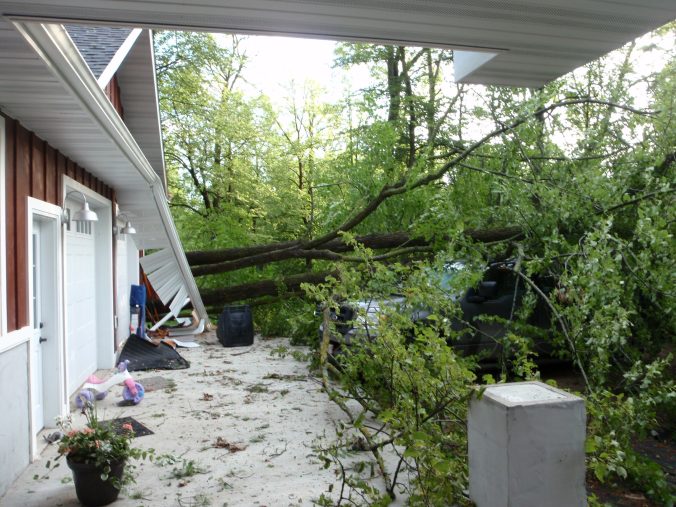
The scene that greeted us the morning of July 21st.

Wednesday, July 20th of this year was another uneventful summer day. At the end of the day, as is my habit, I checked the weather on my iPhone before going to bed. We were in a severe thunderstorm watch, but the radar showed nothing in our immediate vicinity.

At about 1 am that night we were awakened by the storm. Through the strobe-like flashes of lightning we could see trees waving wildly in the wind. We went back to sleep thinking we may have branches and leaves to clean up in the morning.  What we did not know was the storm hitting us was massive and had formed a bow echo on radar, which is an indicator for damaging straight-line winds.

The next morning I took a look around the south (lake-facing) side of the house to see if we’d lost any trees. Other than an accumulation of branches and leaves on and around the patio, there did not appear to be much damage. I finished my coffee, showered and got ready to go to work. (I am working again this summer as an Aquatic Invasive Species inspector.)

When I went out to start loading my truck I went around the northeast corner of the house and could not believe my eyes. A gigantic clump of basswood trees had been blown over, clipping a corner of our new garage and landing on both our vehicles.

I went back inside to let Mel know I would not be going to work that day.

After recovering from the initial shock, I started making calls to insurance companies. Although our brand new house was damaged, we were not upset. Insurance would cover the repairs, which we would have our current contractor (who is still on the hook for a few other punch list items) complete.

We called on friend and neighbor Mike H. for help with getting the tree off our vehicles. He and wife Gail spent most of the day with us cutting and hauling away branches. Mike is a retired tree-trimmer, so his expertise was invaluable. Our daughter Emily’s fiancee Joe J. also was a big help, coming up with a plan to jack the huge tree trunks up so we could back the vehicles out.

We were quite surprised to find that the damage to our vehicles was not as bad as it first appeared. The pickup  (with minimal insurance coverage) got a few more dents and scratches, which blended in with all the other dents and scratches. Although the Outback did not look bad, the body shop estimate still came at over $6000!

But that’s why we carry insurance – no big deal.

The storm’s real damage was down the hill at our cabin.  There we lost nearly all the mature balsam fir trees that provided us shade in the summer and a windbreak in the winter. We also lost a number of other trees between us and the neighbors and even more in the woods behind the cabin. Straight-line winds normally break the tops off trees, which is bad enough. But we had recently had over 12″ of rain, softening the ground so the trees went over, roots and all.

OLYMPUS DIGITAL CAMERA

IMG_1412

IMG_1406

The remaining three balsam firs on the left had to be taken down, as they were partially uprooted and leaning toward the cabin.

Our cabin is currently empty, now that we are in our new home. We hope to use it as a guest house or possibly as a vacation rental property.  We were fortunate that none of the trees came down on the cabin and the damage to our personal property was minor. This stuff is easily replaced.

What can not be replaced are the beautiful mature trees that framed the property and provided its  unique character. The cabin no longer peaks out from under the fir boughs – it sits naked in plain sight now.  These trees were planted and nurtured by the original owners of the property starting back in the 1950s. They had sheltered innumerable family gatherings, graced the property with their fragrant boughs, and took the bite out of the prevailing northwesterly winds that scream across the frozen lake in winter.

We will replant, of course, and try to reestablish some shade with fast-growing aspen and poplar. But we will not see the likes of these beautiful trees on the property again, at least not in our lifetimes.


Who Was Mitchell Spry?

On January 11, 1871 in St. Cloud, Minnesota, Amelia Trotochaud, daughter of Pierre and Angeline Trotochaud of Benton County, was married to Mitchell Spry of Benton County by Father P.M. Stukenkemper. This according to official county records, which also indicated that Pierre and Angeline served as witnesses.  The History of Stearns County, Vol. I indicates that Fr. Stukenkemper was the priest who built the church of the Immaculate Conception in St. Cloud in 1868. That church stood near the location of the present Cathedral in St. Cloud.

So began the Spry family in Minnesota. Our family has long known that Mitchell Spry was born as Michel Surprenant in Canada, but changed his name when he came to the US. Other than this fact, our family knew very little about Mitchell. This has been my main motivation in researching our family history: where did the Sprys come from?

Fortunately, French Canadian genealogy is well documented through the records of Catholic parishes in Quebec, which go back to the 17th century.  The Surprenant name can be traced back to 1678, when Jacques Surprenant, who came to Canada as a French soldier, married Jeanne Denote, who came to Canada in 1665. Jeanne Denote was part of the filles du roi (Daughters of the King), young women, many orphaned, who were recruited and sponsored by King Louis XIV to help settle French Canada. The Surprenants settled in the Monteregie region of Quebec, located south of Montreal and north of Lake Champlain.

Michel Surprenant was born on December 9, 1840 to Joseph Surprenant and Marie Flavie Monet and baptized the same day at St-Edouard de Napierville church, a photo of which is shown below. Michel was the fifth of seven surviving children of Joseph and Flavie. Joseph passed away in 1847.

IMG_0265The US Census of 1850 finds the widowed Flavie and her children living in Mooers, New York, which is located just south of the Canadian border. Julien, the oldest at 22, is listed as a sawyer, and was likely supporting the family. The other siblings were Flavie (19), Peter (12), Mitchel (10), John (Baptiste) (8), and Selena (4). It is not clear why the family moved to New York, although this area had historically been where Canadian refugees from the Revolutionary War were resettled. They may have had family or friends there.

The next record I could find for Mitchell (Michel) was in the 1870 US Census in Benton County, Minnesota. I could find no other record for him in the US for the intervening 20 years, although I did find at least one other Michel Surprenant who was older. I was curious as to his whereabouts during these years and wondered whether he went back to Canada to avoid being drafted into the Civil War.

Meanwhile, I went through some information my mom had compiled about the Sprys and came across a letter from a man named Houde who claimed that Michel Surprenant had a son named Felix by a woman named Leocadie Brunelle. I checked Canadian genealogy records and came across the baptismal record for Felix, which was dated May 2, 1858. Michel and Leocadie were listed as his parents. He was baptized at a church called Ste.-Melanie d’Ailleboust in a village called Acton Vale located in the same region of Quebec where Michel Surprenant was born. Michel would have been 17 years old at the time and Leocadie age 30. Mr. Houde also has several other siblings to Felix listed in his family tree on ancestry.com.

A search of the 1861 Canadian census finds Michel Surprenant living in Acton Vale. Here he is listed in a household with the following:

Benonie Brunelle, farmer, age 61, male, married 1815

Marie D. Brunelle, age 56, female, married 1815

Benonie Brunelle, age 20, male, married 1860

Leocadie B. Surprenant, age 31, female

Felix Surprenant, age 2, male

Ser(aphine) F. Brunelle, age 19, female, married 1860

Flavie Surprenant, age 40, female

Delima Surprenant, age 7, female

Francois Brunelle, age 27, male, married 1850.

Church records indicate that Benonie and Marie were Leocadie’s parents and the younger Benonie and Francois were her brothers.

Interestingly, the census does not list Michel and Leocadie as married. Felix’s baptismal record also points to something unusual about this relationship. Most of the baptismal records, which typically were recorded in same format using the same terms for each, indicate the baby is the product of a “legitime mariage”. This means the church recognizes the parents’ marriage, most likely because they were married in the church.  In Felix’s case the record does not include the word “legitime”. This may mean Michel and Leocadie claimed to be married, but had no proof or were not married in the church. Felix apparently had an older sister, Delima. Because Michel would have been only 13 when she was born, it seems likely she is Felix’s half-sister from a previous relationship her mother had. The woman named Flavie Surprenant may have been Michel’s mother or sister, who shared that name. The woman is listed as age 40; Michel’s mother would have been 51; the sister would have been 30.

Recently I learned that I share DNA with two descendants of Felix Surprise, which confirms Mr. Houde’s claim that Michel Surprenant had a family in Canada. This leaves us with plenty of questions. Why did he leave them? Where was he between 1861 and 1870? Was the name change part of an effort to start over in the U.S., or was he hiding from something?

Felix appears to have spent the rest of his life in Wisconsin. He was married to Marie Barbeau in 1889 and together they had eleven children. In the 1900 US census records, which find Felix and his family in Taylor County, Wisconsin, he uses the name Surprenant. In the 1905 state census and in all subsequent records, he went by Felix Surprise. The last record for him is the 1940 US census, which lists him as a boarder along with two of his sons in Kenosha, Wisconsin. Mr. Houde’s family tree indicates he died in 1945.

It seems unlikely that Felix Surprise and Mitchell Spry met or corresponded as adults. Given that our family was not previously aware of Leocadie and Felix, it is unlikely that Mitchell Spry ever talked about them.

Until now, the Sprys did not know the story of where we came from. As far as I know, we have no stories about great-great grandpa Mitchell. Come to think of it, our family is not good at sharing the stories of our lives. Maybe Mitchell wanted it that way.

What Grandpa Said

Grandpa liked to talk. He was not one to blather on about himself; he did not talk to hear himself talk. But he enjoyed a good conversation, and you could be sure he would do his part to keep that conversation lively. Grandpa’s language was usually colorful and plenty salty but never vulgar. Listening to Grandpa talk was fun because of the things he said.

Grandpa Ray was a master of metaphors and aphorisms, even if he didn’t know what those were. His eighth-grade education did not provide him with much sophistication, but his hardscrabble farmboy upbringing gave him a unique perspective on life and living.

Just as he enjoyed good conversation, he loved eating, and talking about eating.  Coming in from a long day in the fields or woods Grandpa usually had built up a good appetite, often saying “I’m so hungry my stomach thinks my throat is cut.” After enjoying a big meal or an especially good piece of cake or pie, he would say “I wish I was bigger so I could eat more.”

Grandpa always had a colorful way of describing certain events, people or things.  An icy sidewalk was “slicker than snot on a doorknob.” Something moving very fast through or past an obstacle was “like s**t through a long-necked goose.” A guy who told tall tales or talked a lot about himself was “so full of s**t his eyes were turning brown.” Such a man may also qualify for the application of another of Grandpa’s sayings: “he don’t know his ass from a hole in the ground.” He did tend toward the scatological.  When he needed a beer it was because he was “drier than a fart in a windstorm.”

Another phrase he borrowed from Grandma. Whenever she talked about something she didn’t like or didn’t understand she would use the term “ferluvnermunny”.  For example, when talking about traveling to or in the Twin Cities she would say, “why, the traffic down there is just crazy. Cars coming at you from all directions. I wouldn’t live down there ferluvnermunny.” Translation: for love nor money. It kind sounds like she considers these equivalent, but I don’t think that’s what she means. Even today Grandma often evokes Grandpa: “I know Raymond always used to say…”

A lifelong Democrat, Grandpa was not above talking politics.  A favorite saying he borrowed from his dad, a farmer, went as follows: “Never trust a man in a suit. He may be a banker or a lawyer or a revenuer. But you can be damn sure he’s a Republican.” I never thought of Grandpa as a racist, but he would occasionally say things that made me wince. Southern Minnesota farm country in the 1920s and 30s was not a place you where you would learn about racial justice. Grandpa was a product of his time.

One of the funniest things I ever heard Grandpa say happened on a fishing trip in Canada. This story requires a little background, but I’ll write more about our Canadian adventures in a future post.  On my third trip there, when I was about 15, I was lucky enough to hook what was probably the biggest pike I’ve ever seen.  I fought it for about 20 minutes, trying to get it close to the boat so Dan, the guy sitting in the bow, could net it.  Finally, I got it within three feet of the gunwale and Dan reached out with the net. He got the fish just out of the water; I remember it barely folding up in the net. Then the big pike straightened out and the next thing we heard was a big SPLASH! The fish was gone. The double-hooked smelt rig I had on was mangled, the hooks almost straightened back into wire. The pike had torn a gaping hole in the net. (It turns out Grandpa packed an old, rotting landing net instead of a new one he’d bought for the trip.) I turned to Grandpa who was manning the motor and said, “I don’t know if I should laugh or cry.”

When we got back to our fish camp that afternoon, the story was told and retold to the guys in the other boat, who had gone a different direction that day.  As the beer flowed and the whisky bottle made its way around the campfire, the one that got away got bigger and bigger.  Apparently, it was the biggest fish Dan had ever seen too.  He couldn’t stop talking about it. Finally, Grandpa got tired of hearing him talk about it and said so. Then he said:

“Your mouth is flapping like a whippoorwill’s ass during chokecherry season.”

The little fish camp erupted with laughter. We were literally rolling on the ground with tears in our eyes. They could probably hear us in Winnipeg that night.

Grandpa was never a rich man, but he knew how fortunate he was. When he was relaxing in a boat or a lawn chair or driving through the countryside just enjoying the day, he would say “I wonder what the poor (or rich) people are doing today.” He wasn’t a snob, but he felt rich.

This is what I take away from my experiences with Grandpa Ray. Anyone who enjoys life as he did is rich indeed.

Grandfather Oak

You stand erect, unbent by the wind, challenging the clouds.

Burly limbs, dark and sinewy, like a wrestler’s arms, reach to possess the sun.


You do not put on airs like your neighbors the maple and the linden.

They are graceful, lyrical; you are stolid, silent.


They dress in gay colors, dancing through the fall, ignoring winter’s threat.

You fade to tans and grays, the colors of a workman’s clothes, and await the ice and snow.


You hold the power of the sun inside you, locked in against the cold.

You stand dark and silent against the snow-filled sky and wait to bring green again.


You stand as a silent witness, a keeper of stories.

You listened to the hunters and the berry pickers as they camped under your leaves.


You knew the noble pines who once ruled the land.

You survived the onslaught, but will not tell the tale.


You witnessed the dawn of machines. You watched the lights cross the sky.

You stand in this forgotten corner and will never feel the sting of the saw.


You do not stand against time. You are time.


Almost a House

IMG_1265

We’re almost there – just waiting for the concrete guy to come back to polish the floors one last time, and for the tile guy to seal the grout in the showers. A year ago we started with high hopes – our custom design was perfect and we had the best contractor in the area, who told us we would be in by the fall – of last year.  After months of waiting for subcontractors to show up, worrying over details (“the wood stains don’t match!”) and lamenting  the lack of communication with our general contractor, we have moved beyond frustrated to complete mental exhaustion. But we are finally seeing the light at the end of the tunnel. We have been incredibly blessed and fortunate.  Soon, we’ll be moving in to our new house.

We should be really excited about this. But we’re approaching the move-in with not a little anxiety. What if our design is seriously flawed? Will we stay warm enough in the winter and cool enough in the summer? Will we still like our cupboards/windows/floor/whatever in 10 years or 20? Should we have made this room bigger? Should have put in more windows? People say you should build two houses, the second one to fix all the mistakes you made the first time.

But our uneasiness may have deeper sources.  It is too easy to fall into the habit of thinking the new house will fix all our foibles – we’ll be better organized, we’ll clean up after ourselves, we’ll exercise more and eat and drink less.  The new house will bring out our creative selves, make us better gardeners, better cooks, better hosts. I’ll write more. We’ll make a strong effort to be the people we ought to be, but the reality is we will no longer have the lack of storage space or sunlight or outlets or counter space as excuses for being lazy slobs.

We have a mountain and several foothills of stuff in our pole shed and more in off-site storage. We know it won’t all fit. We are reluctant to get started – not the least because the job will be more like an excavation than an orderly move. As the year went on, stuff got heaped on stuff, stuff was pulled out early, from the bottom of piles, causing avalanches of stuff.  We started packing over a year ago, before Emmaville was sold. We knew just where everything would go and had a brilliant plan to keep it all organized. Now we can’t remember what we have where. Just as the building process had peaks and valleys, we anticipate the moving process will have moments of joy (“Oh, I forgot we had this! This will look perfect.”) and moments of exasperation (“Why did we keep this. What the hell are we going to do with it?”).

Hopefully in another year, we’ll find ourselves relaxing on our patio after a great day spent tending the garden or creating something beautiful and will realize we are content. Even if there is a sink full of two-day old dishes, a basket of unmatched socks on the couch and boxes in every room still waiting to be unpacked.


A Tragic Loss

Sauk Rapids Sentinel article

When I last posted on the Minnesota History page, my great-great-great-grandparents Pierre (Peter) and Angeline Trotochaud were homesteading on Little Rock Lake near present-day Rice, Minnesota in the 1850s and 60s.  The following is reproduced from the Sauk Rapids Sentinel, dated August 20, 1869.

A son of Peter Trotocheau of Little Rock Lake, ten miles above Sauk Raids, was killed by a Chippewa Indian, on Monday last. The circumstances as we have gathered them are as follows: Four Indians, said to be of the Mille Lac band, arrived at Little Rock a short time before the murder, and in the sports a wrestling match took place between one of them and Trotocheau, a young man about 18 years of age. He proved too much for the Indian and threw him. The young man seemed to think no more of the affair, and engaged in a game of cards. He was out in the open air, seated on the ground. One of the Indians laughed at his comrade for allowing the boy to throw him, and jeeringly asked him why he did not do as he said he would.  Upon this the murderer went into a lodge close by, procured a knife, approached the young man, and while his head was bent forward gave so heavy a blow with the knife on his forehead that it penetrated his head, splitting it nearly open, from the effects of which he died almost instantly. The murderer ran into the woods, pursued by some of the Halfbreeds residing there, accompanied by two other Indians; but he made his escape, and we believe he has not yet been heard from.  Mr. Osgood, Sheriff of Benton County, we understand, has gone up to the Chippewa Agency to get the assistance of the Agent in arresting the murderer.

The person murdered is quite a boy, but we never heard aught against him. His father is well known in our county as a good industrious Canadian, and has the reputation of being a very honest man. He is almost crazy over the tragical death of his sone, and we really hope that something will be done to bring on the murderer condign punishment.

These savages must be taught that they cannot commit such acts with impunity….The mother of the murdered boy is, we think, one-eighth Chippewa. She is a quiet, inoffensive woman, and much respected by those who know her. She is the mother of some eight or ten children, but we understand that this boy was her only son. This poor woman has the sympathy of all her acquaintances.

Grandpa Ray and Will Rogers

Ok, so Grandpa never met Will Rogers.* But he felt the same way as Will, who once said, “I never met a man I didn’t like.” Grandpa could make friends with just about anybody. He was especially good at making friends with people who knew where the fish were biting.

Of course, Grandpa met a lot of people over the years, at the Cozy Coach in Westbury, delivering mail, as a county agent, selling crop insurance….Even those who didn’t know him in the area knew of him. At Emmaville a couple of years ago, I met a man named Ron who grew up around Two Inlets, another small berg in the middle of nowhere, and who enjoyed the occasional beer in the Two Inlets Store. Grandpa and Grandma had some good friends who were Ron’s neighbors and often met them for beers around the little horseshoe bar at the store. Ron didn’t recall Grandpa by name when I mentioned him, but when I described him, he knew exactly who I was talking about: “oh, yeah, real loud guy, laughed real loud and drank a lot of beer.” Yeah, that was my Grandpa.

Grandpa loved to stop at small roadside taverns (he called them beer joints) when he traveled, and always managed to strike up a conversation with someone. Story after story was told. One round would lead to another, and the next thing you know, Grandpa was planning a fishing/hunting/camping trip with the guy. He and Grandma had friendships with people all over the country, dating back to the 1940s. Year after year, Grandpa or Grandma would call them up just to see how they were.  Grandma was a good letter writer and kept up correspondence with a lot of the folks they met.

Every summer, all summer long, Grandpa and Grandma would have company. Friends would come from far and wide to stay and do some fishing down at Floyd Lake. Grandpa never passed up the chance to take his guests fishing.  He reveled in watching their reactions when the sunnies were really biting.

Grandpa was fascinated with the way people lived in other places and in other cultures. He often told the story of some folks from Chicago who came for a wedding. Upon arrival at my grandparents’ farm in the woods, the city folks marveled at the surrounding “wilderness”. One man wondered how anyone could make a living where there were no offices or factories. After Grandpa had given the bride and groom a celebratory ride in a manure spreader behind his tractor, one of the Chicagoans asked about the contraption. Grandpa asked the fellow if he had been in the army and if he remembered “honey wagons.” The light of recognition went on; they had found a way to relate. That story always made him chuckle.

In their later years, Grandpa and Grandma spent the winters near Brownsville in Texas. After spending a few years trying to figure out how to fish the Rio Grande, Grandpa befriended a Mexican-American guy he met on the river.  Soon he was having success on the Rio, but he also enjoyed visiting the man and his family and learning about their lives.

A more poignant story involved Grandpa’s one and only elk hunt in Montana.  After several days of hard hunting, he was still waiting for an opportunity to see elk within shooting range.  Driving near Neihart in the Little Belt Mountains, Grandpa and his friend Darrell Abbott, a rancher from Gilt Edge, spotted a herd of cows several hundred yards away.  Grandpa decided it was his last best chance, got out of the truck and took a shot. It was a good one – he knocked a cow elk down. While Darrell continued hunting, Grandpa hiked up to his kill and began dressing out the elk.  As he was working away, he began to wonder how in the world he was going to get the elk down from the mountainside.  Just then, another hunter came along on horseback and offered to help.  He showed Grandpa how to quarter and bone out the animal and together they packed the meat down to the truck.  By the time they were done, Grandpa had a new friend.

The man was a local, a retired prison guard and offered to host Grandpa the next year on another hunt.  Grandpa was excited about the trip, having talked with his friend during the year to firm up plans.  Then he got the sad news: his new friend was killed in a car accident, pulling out of his driveway.  Grandpa and Grandma traveled out to Montana for the funeral of his friend. He never went on another elk hunt.

I often wish I had friends like Grandpa did. I tell myself these are different times; people don’t socialize like they used to do. But really, the formula remains the same: make a friend, be a friend. Stay in touch. Make plans and follow through. Whenever I think about the way Grandpa lived I am reminded that having friends is a responsibility.

Another famous man Grandpa actually did meet, Hubert Humphrey, once said, “the greatest gift of life is friendship and I have received it.” Grandpa may not have said it in so many words, but his life reflected this truth.


*Sorry, I couldn’t resist using that title as a hook!


The War on Shrubs

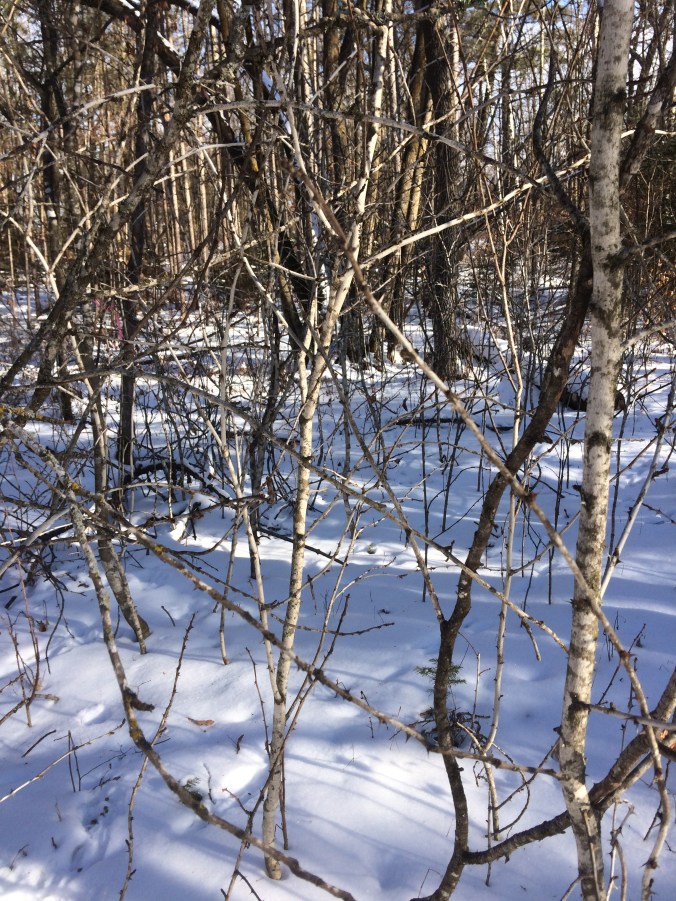
Shortly after Mel and I bought our 11.78 acres of brush and swamp nine years ago, I cut a loop trail through the woods.  Other than having to clear a few downed trees, all I had to do was cut some brush to clear a path.  This brush was actually shrubs and young trees vying for limited sunshine under the old basswoods that dominate our woods. At one point along the trail, I encountered some chest-high woody plants with nasty quarter-inch thorns.  I assumed these were hawthorn or some such thorny shrub, cut my way through them and moved on down the trail.

We used the trail in winter to cross-country ski and in spring to find emerging wildflowers. It only took about ten  minutes to make the loop on skis, but three such loops made for a decent morning workout.  I had to do a little maintenance every year, but I saw it as a good excuse to spend some time in the woods.

After we bought the defunct Emmaville Store six years ago, we found that getting time at the cabin was getting harder and harder to come by. Our little loop trail fell into disuse.

Last summer, after selling Emmaville as a going business, we came home to the cabin and a backlog of maintenance items. After working my way down the honey-do list, I finally made it back out to the woods.  Our trail had grown over again in many places. As I walked it and contemplated clearing it again, I came across a tall jungle of the same thorny bush I encountered eight years before. What was then a bathroom-sized patch was now an impenetrable tangle occupying nearly half an acre.  Some of the plants were approaching tree size. 

Upon further inspection, I found that this mystery shrub was growing so densely that other shrubs and tree saplings were being excluded.  Whatever this thing was, it wasn’t good for our woods. I suspected it was buckthorn, an invasive plant that is becoming widespread in Minnesota.  But this plant did not match the description for buckthorn. 

Eventually I identified the beast as prickly ash, a native species. I read that the plant is useful for herbal remedies (another name for it is “toothache tree”) and the larvae of some butterfly species favor it.  But, according to the Minnesota Wildflowers website, “the spreading, shallow root system will send up new suckers when not inhibited by competing vegetation, creating dense thickets of nearly impenetrable brush that tears at the hands, face and clothing.” Yep, that’s the one.

IMG_1069

We have every intention of letting nature take its course in our woods.  But we want to make sure we have healthy trees coming up to replace the mature and over-mature trees.  The prickly ash is out-competing more desirable species such as maples, oaks, alders and dogwoods.  Also, we would like to walk in our woods without getting bloodied. I decided the prickly ash needs to be controlled.  I found out the hard way that just cutting it does no good, but probably encourages its spread. Also, losing the old basswoods and other trees to blowdown is creating new openings for prickly ash to occupy.

Late last summer I sprayed a 2,4-D based herbicide on the plants around the perimeter of the thicket to see if that would slow down its spread.  I’ll find out this spring if that worked. Everything I have read on-line suggests the best control is to cut the stems and immediately spray the stump. I might try starting some aspen cuttings to fill in where the prickly ash was. I am hoping I can whittle away at this problem over time to keep it under control.  Oh well, I guess I will have to spend more time in the woods…..

Life at Little Rock Lake

When we last visited Pierre and Angeline (Blair) Trotochaud, they were living at Little Canada on the outskirts of a young St. Paul in 1850. The next data point is 1856, when Pierre filed a land claim in what was to become Benton County. The claim was located next to his brother-in-law Antoine Blair, who had settled there sometime before 1849. These homesteads were located on the western shore of Little Rock Lake, about 1.5 miles east of the present-day town of Rice. The area was an important historical nexus, where the Oxcart Trail ran along the east side of the Mississippi River, where several trading posts were located and where Peace Rock, a granite outcropping along the river, marked the boundary between the Ojibwe and the Dakota nations.

At the time Pierre had proved up his homestead claim, he and Angeline had five children: Margaret, born in 1845, Sophia (1847), Peter (1850), Amelia, the future Mrs. Mitchell Spry (1852), and Eliza (1855). A second son, Moses, came along in 1857.

Minnesota had been a territory since 1849 and was on the verge of statehood. A final territorial census was completed in 1857, which listed “Pierre d’Autrechaud” as a hunter. This suggests Pierre was paid to hunt, probably to supply local merchants. This was a natural extension of Pierre’s previous life in the fur trade.  David Gilman, previously mentioned on this blog (see “Uncle Antoine”) owned a hotel at Watab and may have employed Pierre to supply the dining room. Pierre’s game bag probably included deer and waterfowl. Bison and elk had already been wiped out in most of Minnesota by that time. The continued loss of game in the area probably made this a short-lived occupation for Pierre.

The 1860 federal census lists “Pierre Trotocheau” as a farmer with real estate valued at $400 and personal property at $100. Oldest daughter Margaret, then 15, was listed as a domestic servant. Margaret probably worked at the Watab hotel, as there does not appear to be anyone in the area in 1860 who had the wherewithal to employ servants. Another son, Joseph, was born that year to Pierre and Angeline.

The 1860s were a turbulent time in the area. More and more settlers were moving in, increasing the demand for land. The Ojibwe were subject to continuing pressure to cede lands and move to reservations. Their old enemies the Dakota (Sioux) had already been moved on to reservations along the Minnesota River in southern Minnesota. In August 1862, The Dakota, fed up with their treatment by Indian agents and traders, started attacking white settlements beginning what became known as the “Sioux Uprising”.

The Ojibwe were approached by emissaries from the Dakota to join them in the war. Hole in the Day the Younger had made himself the leader of the Ojibwe, a position he inherited from his father Hole in the Day the Elder and maintained through oratory skills and force of will. Hole in the Day the Younger, who was based at Gull Lake, decided to join the Dakota and had sent his own emissaries to Leech Lake and Red Lake to rally the other bands. Hole in the Day was also the nominal leader of the Ojibwe people living in the large village between Watab and Little Rock Lake, near the Trotochaud and Blair homesteads.

Had the Ojibwe entered the war, white settlements along the Mississippi all the way down to St. Paul would likely have been attacked and a great many more lives lost. Credit is given to Father Francis Pierz, an Indian missionary priest, for convincing Hole in the Day to choose peace over war. Father Pierz had been a missionary to Indians around Lake Superior since the 1830s and had been assigned by the new bishop in St. Paul to minister to Indians and whites along the Mississippi for 100 miles above St. Paul. Father Pierz established a parish at Crow Wing in 1852 and parishes at Belle Prairie, Swan River and Sauk Rapids in 1853, St. Cloud and St. Joseph in 1854 and St. Augusta in 1855.

For the Trotochauds, the nearest parish would have been Sauk Rapids, about 12 miles to the south. I have not found any information to indicate whether the family were practicing Catholics. There may be mention of them in Fr. Pierz’s baptismal register, which may still reside at the Belle Prairie parish.

The Trotochaud family continued to grow at Little Rock Lake. A son, Antoine, was born in 1862 a daughter, Delphine, in 1866 and another daughter, Christine in 1869. According to the 1870 Census, the Trotochaud homestead was still valued at $400 but the personal property was now valued at $500. Around this time, Pierre Trotochaud was listed as one of the top producers of wheat in Benton County.

In spite of their prosperity, the Trotochauds experienced a shocking tragedy in 1869. More on this to follow in the next post.