The Boy with the Red Wagon

Rudolph Nester was born in Baden, Germany in 1856. In 1873, at the age of 17 he emigrated to the US. In 1880, he married Mary Heembrock, the daughter of an established German-American farmer from St. Charles, MO. Later that same year, the 1880 census has them farming in Dora Township, Otter Tail County, MN. Apparently, Rudolph was able to get work, woo a woman and make enough money to stake a new homestead in the 7 years since he emigrated.

The claim was 160 acres of bare land between West Spirit Lake and Otter Lake. Otter Tail County was previously the home of Ojibwe and Dakota people. The last remnant of Ojibwe, members of the Pillager Band, moved to the White Earth reservation after it was established in 1868. Rudolph and Mary patented the homestead in 1885. Mary’s brother John received a patent for an adjacent claim in 1890. Most of their neighbors appear to have been fellow German immigrants, with names like Schimmelfenig, Wagner and Klug.

Rudolph and Mary had a big family: 9 children (8 who survived to adulthood) between 1881 and 1898. Devout Catholics, they may have attended Mass at Dora Catholic Church, which was located about 3 miles to the southeast. Oldest son Joseph went west to find his fortune; his WWI draft card has him in Montana working as a stone cutter.
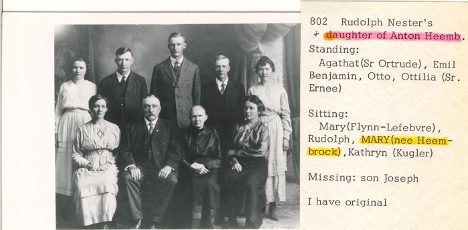
As second son Emil came of age, Rudolph decided to buy land that had recently become available on the White Earth reservation as a result of federal legislation (see blog post “A Model Reservation”). He may have purchased the land from Zoe (Zoway) Fairbanks, the original allotee. Zoe was issued the allotment in 1889 and patented it in 1902. A plat from 1904 shows her ownership.

The parcel Rudolph bought was 75 acres on the north end of Fairbanks Lake, about 4 miles south of the White Earth agency. It’s not clear whether the land had been cleared or plowed or whether Zoe Fairbanks lived there before the sale. In family stories, Emil is said to have spent a year there before getting married. It may be that he cleared land and built a home there during that year. Today, the land is partially forested and partially cultivated.

On February 11, 1911 Emil married Annie Poss, daughter of Jacob Poss (Paas) who farmed along the north shore of Lake Lizzie in Otter Tail County. They moved to the Fairbanks Lake property and began their family. Their first four children, Alice, Lucille, Irene and Clifford were all born on the farm.

The Nesters attended Mass at St. Benedict’s Mission, located two miles north of their farm. The Mission was run by Fr. Aloysius Hermaneutz, OSB who served the people at White Earth for over 50 years. The older children attended school at the Mission. The family witnessed the wholesale transfer of land from the White Earth Ojibwe to white settlers firsthand. This period was a dark chapter in the history of the reservation as tribal members lost the land base they needed for subsistence.

In 1919, Emil and Annie sold their farm and auctioned off all the equipment and livestock. They moved into the new town of Callaway and joined Assumption Catholic Church. Emil went into business as a butcher with Harry Hanson, another former farmer. Eventually, Emil bought out Harry and owned the business, which included a meat market, outright. By 1923, Emil was part-owner of a movie theater in the bustling town. After Prohibition ended in 1933, Emil opened a “beer parlor” by partitioning off part of the meat market.

As with many small towns, Callaway suffered during the Great Depression. Emil was forced to close the meat market. The movie theater was no longer operating and the beer parlor became Callaway’s first municipal liquor store. Emil managed it for a short time. He also continued custom butchering, traveling from farm to farm.

At about this time, Emil and Annie’s daughter Irene or “Diz” (short for Dizzy) began dating a young man named Bud who lived on a farm north of town. Bud’s parents had also experienced adversity, having the lost the farm in the late 1920s. Pete and Addie rented it back from the state and raised their 10 children there.

Although Bud’s family attended the same church, they didn’t move in the same social circles as the Nesters. In fact, when Bud and Diz announced their engagement, Emil was not happy because Bud was an Indian. Emil forebade members of the family from attending the wedding. This kind of prejudice was not unusual around the reservation at the time.

Immigrant families flocked to White Earth in the land rush that resulted from the federal allotment policies. For these families, owning land meant having the opportunity to establish and better themselves in their new country. They could not understand why tribal people did not take advantage of their “opportunity” to become farmers.

The few tribal members who did become farmers were mostly the mixed-bloods, like the Sprys. Although they were living and working hard like their white neighbors, they could not escape being painted with the same brush as the more traditional tribal people who depended on subsistence. They were all “lazy Indians” in the eyes of some whites, apparently including Emil.

Bud and Diz were married on October 25, 1937. Bud’s brother Elmer and Diz’s cousin Alice Lefebvre were the witnesses. One of Diz’s sisters, probably Hazel, snuck out of the house to attend.

Bud and Diz got off to a rough start. Bud had started working at Johnson’s Bee Farm in Callaway but it was seasonal work. To make ends meet, Bud worked in the woods in the winter months, cutting firewood to sell. At one point, to save rent money, Bud built a log cabin near St. Clair Lake.

After a couple of miscarriages, Bud and Diz welcomed a son, Jerry (my dad) in 1939. Jerry was born in the old White Earth Indian Hospital. Because he was a bit premature and very small, the nurses put Jerry in a shoebox on the mantle of the big fireplace in the main lobby of the hospital. The nurses doubted he would survive but he did. Bud and Diz brought Jerry home to the little cabin. Diz recalled melting snow in the winter for baths and laundry. She had to learn to cook and bake without eggs. It was primitive living but they had lots of company; their friends came by to see how they were doing and to play cards. They were happy.

Eventually, Bud and Diz and their family moved into Callaway. They rented the upstairs of a small home, next door to Emil and Annie. Bud continued to work at Johnson’s Bee Farm. Although they were next-door neighbors, Bud and Emil didn’t talk. Emil refused to acknowledge Bud as his son-in-law.

Life went on for the Sprys as their little family continued to grow. Bud was a good baseball player and played for Callaway’s town ball team in those days. He was known as the left-handed catcher who batted from the right.

When WWII started, Bud and Diz had two small children: Jerry and his sister Cleo. Bud apparently was deferred in the draft as a father. His brothers Elmer, Lee and Ervin (Bunt) all served. As for Emil, family lore has him working on the Alaska Highway construction project as a cook. Later in the war, Emil and Annie both worked at the Hanford Works, which was part of the secret Manhattan Project. According to Grandma Diz, they worked in the mess halls, Emil as a butcher and Annie preparing vegetables. (Side note: 50 years later I was working at Hanford in an office building built on the site of one of the work camps.)

Finally, back home in Callaway Emil and Annie resumed their lives. One day Emil noticed a little boy playing with a red wagon on the sidewalk in front of his house. He was handsome little guy, with dark hair, his mom’s blue eyes and a quick smile. Emil and Annie invited the boy into their house. That little boy was Jerry, who eventually won his Grandpa over. Soon Bud and Emil were on speaking terms and eventually became close friends.

Later in the 1940s Emil was in a terrible car accident. He never fully recovered from his injuries. In his last days, the only person Emil wanted at his bedside was Bud.

Driving Highway 113

Over the past two years I’ve spent a lot of time traveling Highway 113 on my way to board meetings in Waubun and Mahnomen. While driving, I’ve been reflecting on what this highway has meant to me over the years and how it informs my perception of home.

Minnesota Trunk Highway 113 starts on its western end out in the Red River Valley, continues through Waubun and ends at US Highway 71 where it forms part of the south boundary of Itasca State Park. The highway is flat and straight coming from the west until it encounters the Waubun Hills and begins its twisty, hilly journey through lake country. The speed limit over much of this stretch is only 50 mph, on account of the sharp turns, narrow shoulders and limited sight lines along the road.

It is the route many summer homeowners from western Minnesota and North Dakota take to their bit of paradise on one of the many lakes in the area. Winding back and forth over the Mahnomen and Becker County lines the road showcases a beautiful slice of northern Minnesota with numerous lakes and ponds and thick forests of hardwoods, pines and spruce.

While there is private land, especially close to the lakes, much of the land on either side of the highway is publicly held, either as state forest or tax-forfeited land managed by the counties. A large block of land extending north from Tulaby Lake, through the Naytahwaush area and on north of Highway 200 is tribal land that is closed to non-members. This is the largest block of land on the White Earth reservation that is held in trust for the White Earth Nation.

Growing up as a kid, I heard a lot of stories set “up on 113”, giving the area a certain mystique in my mind. In my early years Highway 113 represented a remote, wild place deep in the heart of the White Earth reservation. This was the home of mysterious places like Long Lost and Bad Medicine Lakes.

Many of the stories I heard back then were about deer hunting. Great-grandpa Pete Spry and Grandpa Bud Spry hunted north of the highway back in the 1940s. Back then it was just a rough, muddy gravel road. My dad began hunting with them as a kid in the 1950s. He recalls traveling to deer camp in Uncle Dan Clark’s gravel truck with chains on; it was the only vehicle that could get them back into their camp in the woods near Long Lost Lake. Dad says he remembers seeing camps along 113 on nearly every curve in the road.

Grandpa Bud at deer camp ca. 1950

The crew in that deer camp included several guys from Callaway. They stayed in a tarpaper shack. Dad recalls watching them get up in the morning. Grandpa Pete would roll out of bed and immediately light a cigarette. The men passed a bottle of whiskey around to serve as mouthwash. In later years, they hunted out of an old converted school bus. When Grandpa Pete couldn’t walk as much in the woods he sat in the bus’s driver seat and shot deer out the window. My uncles and cousins still hunt north of Highway 113.

My first experience of this area was camping trips with cousins and friends to a lot on Pickerel Lake. The bare gravel lot got pretty hot on those summer days so we spent most of our time swimming in the clear, cold lake. When we weren’t swimming we hiked over to Hoot Owl Resort to buy candy. The adults spent most their time in a screen tent to avoid the bugs and maintain easy access to the keg of beer.

Later, in my high school summers my Grandpa Ray and I traveled up and down Highway 113 to plumbing jobs at tribal housing projects in Elbow Lake Village, Naytahwaush and Rice Lake (see “Rez Plumbers” blog post). Some days when we got done early we would explore one of several forest roads or “truck trails” that extended north and south of 113. With names like Anchor Matson and Strawberry Mountain these roads were a link to earlier years when logging dominated these woods.

After a long day, Grandpa would often take a nap and have me drive the winding highway home. Occasionally we would stop at McCraney Lake, where a bar in a Quonset hut served burgers.

That Quonset hut is long gone now, as are many of the little cabins the lined the lakeshores. Today in their place are large vacation homes. Otherwise, Highway 113 remains much the same, winding its way over knobs and around kettles left by the last glaciers. I still enjoy the remote beauty as I take my time at 50 mph.

Marking Time

24B92C05-3845-4D72-BA12-4E30BF257C5DIn this time of COVID-19, many are learning to slow down, take more notice of things around them and appreciate what they have. Even for me, someone who has been retired for several years and has all the time in the world, there seems to be a slower pace.

This Spring I’ve been doing what I do every spring: checking out the emergence of the plants and animals that tell us winter is over and summer is on its way. This is known as phenology, “the rhythmic biological nature of events as they relate to climate” to quote my friend John Latimer. John does a weekly phenology report on Northern Community Radio (Kaxe.org) wherein he discusses his observations. He also does a “daily dose of phenology” in which he looks back at his records to see what was happening on a given date. It’s sounds geeky (and it is) but its a great way to relate to the land around us and remember we are a part of something bigger.

I have been trying to keep phenology records for the past few years but often am too rushed to remember what I saw and write it down. But this year, I find myself taking the time everyday, not just some days, to notice what is happening in the natural world. I’ve challenged myself to find something new everyday or at least write down something I saw or heard, that got my attention. I made some early observations in March but I didn’t start writing things down everyday until a few weeks ago. Here is my daily log for the Spring so far, including observations while at work, but mostly at home:

April

27: hepatica beginning to bloom

28: rue anemone, marsh marigold beginning to bloom; first-of-the-year (FOY) white-throated sparrow

29: aspen catkins dropping

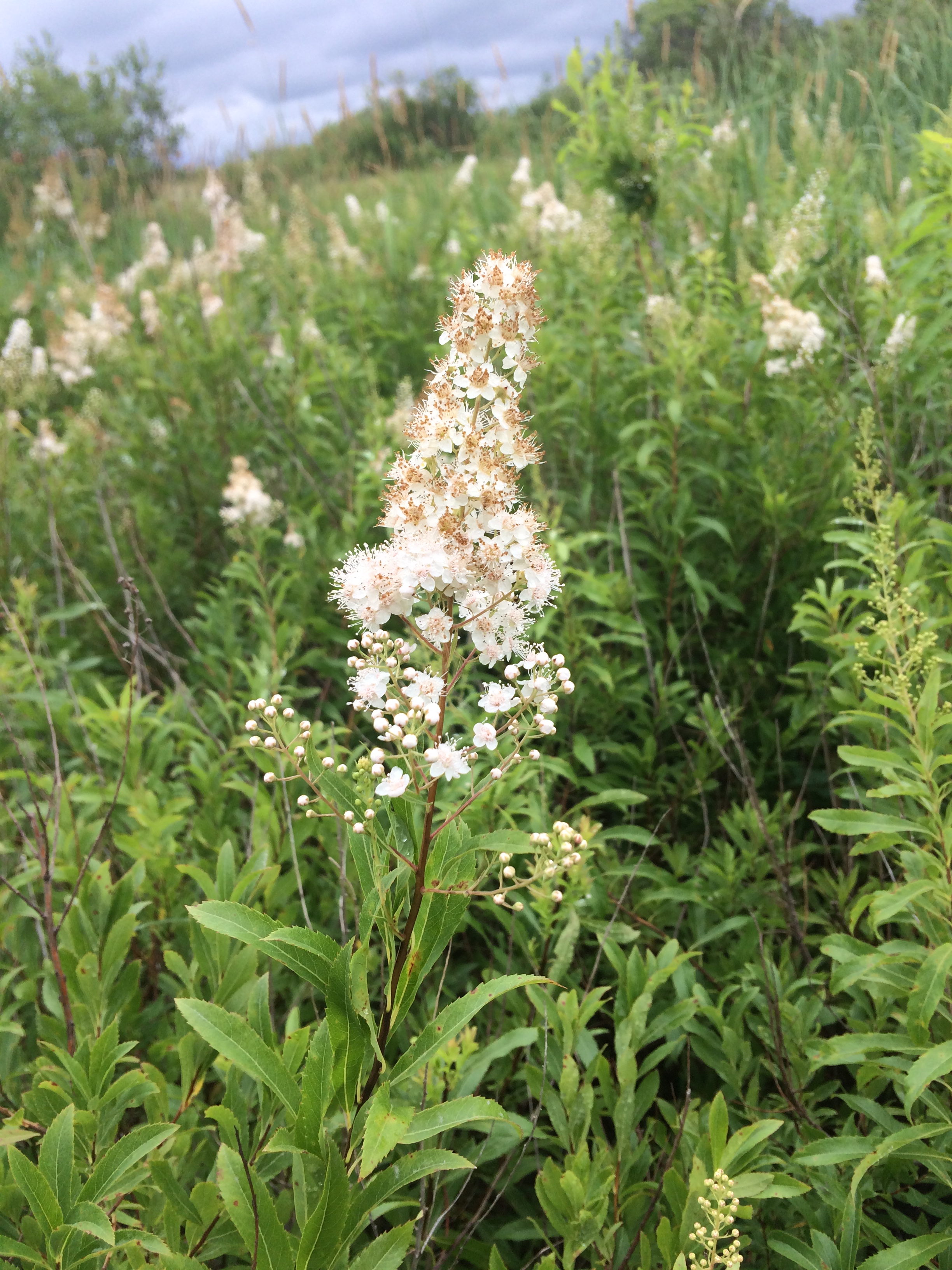
30: sandhill cranes calling from the cattail slough (see home page photo)

May

1: snowberry, chokecherry leafing out

2: leatherwood leafing out

3: bellwort emerging; wood anemone flowering

4: FOY phoebe

5: Pennsylvania sedge flowering

6: wild ginger flowering

7: aspens leafing out

8: red maples leafing out; cattails emerging

9: FOY warblers: “butter butt” (yellow-rumped), palm, pine (observed at Big Sand Lake access)

10: green ash flowering

11: large-leaved aster emerging

12: FOY spring azure and fritillary butterflies, black and white warbler (Greenwater Lake Scientific and Natural Area)

13: oak trees flowering

14: FOY yellow warbler

15: FOY Baltimore oriole

16: trilliums have emerged, ready to bloom

17: wild plum blooming; FOY sharp-shinned hawk (Big Sand Lake access)

The natural world keeps on keeping on, regardless of what is happening in the “human” world. We get busy creating our own reality with work, politics, sports, celebrity gossip, etc. We seem to be in a competition to see who can accumulate the most, which really means using up and throwing away the most.

COVID-19 is a reminder that the natural world is the “real” reality and still is in charge. We may think we control our destiny, that the world exists for us to exploit. Along comes a bit of protein-coated RNA, (see my post “Virus”) one of millions of viruses that exist in nature, and our world is turned upside down.

We are not in control. Nature is, always has been, always will be.


Shivaree in the Judiths

shivaree noun
shiv·​a·​ree | \ ˌshi-və-ˈrē , ˈshi-və-ˌrē\
Definition of shivaree: a noisy mock serenade to a newly married couple. In 19th century rural America, a newly-married couple might be treated to a mock serenade, performed with pots, pans, homemade instruments, and other noisemakers. In much of the central U.S. and Canada, … it was called a “shivaree,” a loan from French charivari, which denotes the same folk custom in France. 

In 1989, my grandparents invited me to hunt deer with them in the Judith Mountains near Lewistown, Montana. My family had been hunting there since the 1950s and I grew up hearing dozens of stories about their hunts and the beautiful, historic area. Living a few hours away in Idaho at the time, I jumped at the chance to tag along.

Our family hunted on the Abbott Ranch on the eastern edge of the Judiths near the ghost town of Gilt Edge. The owners were direct descendants of “Teddy Blue” Abbott, who had come north from Texas on longhorn cattle drives. Abbott worked for Granville Stuart, a prominent Montana pioneer, on his ranch and eventually married his daughter. Teddy Blue’s memoir, We Pointed Them North, was published just before his death in 1939. Teddy Blue was a good friend of Charlie Russell as well as Calamity Jane.

I met Grandpa and Grandma, as well as Grandpa’s cousins Stan and Edwin Tuve, along with Edwin’s wife Marie, at the Lewistown VFW. Because I had run out of gas on the way, I was about 3 hours late and the party was on. Eventually, we made it out to the ranch and set up camp near the outbuildings.

The next morning, Grandpa posted me at the top of a draw and he and Grandma, ages 69 and 66 respectively, made a drive for me. That is, they walked up the draw to kick deer out toward me. I got my deer right away. Afterward, while we were waiting for someone to come with the pickup to load the deer, Grandpa and I sat in the meadow and passed a bottle between us. After listening to Grandpa’s stories about Montana deer hunts all my life, I could not believe I was there with them, a part of it all.

Later that day, I was assigned again to post along with Grandma. As we were walking toward the ridge where we were to position ourselves, a deer came bounding over the top of the ridge at full speed. Mule deer, unlike whitetails, tend to run stiff-legged, making it look like they are bouncing across the ground. They do not seem fast but they’re still tough to hit. I watched Grandma pull up her Winchester .32 Special and drop the deer with one shot from about 60 yards. It was well known in the family that Grandma was the best shot; I got to confirm that in person!

The rest of the hunt was a lot of fun as we had little trouble filling our tags. As the only non-senior citizen in camp, I was obliged to do most of the dressing and dragging of deer. I didn’t mind the work one bit. It was on the warm side for October, so we skinned the deer and hung them in one of the ranch sheds.

It was the perfect weekend: beautiful weather, gorgeous central Montana scenery, Grandma’s delicious cooking and great stories around the fire. Grandpa and Grandma’s 49th wedding anniversary happened to fall during the weekend. As they were in the camper preparing supper that night, the group got together some pots and pans and lids and spoons and shivareed them! We kept up the racket until Grandma and Grandpa came out of the camper and gave us a kiss. We celebrated with a beautiful cake baked by Mrs. Abbott in a wall tent also provided by the Abbotts.

Little did I know this would be my last hunt with them. I never got back to Minnesota to hunt with them before Grandma “retired” and Grandpa passed away. I will always treasure the memory of this hunt.

******

We lost Grandma Arleen last week, at the age of 96. She is at the center of so many of my memories; it’s hard to imagine life without her. These last few years I was able to visit her often and listen to her stories. I am grateful for the time with her. Now she is back with Grandpa, on another grand adventure.


“A Model Reservation”

Callaway TWP

When we last visited Mitchell and Amelia Trotochaud Spry, they were settled on a farm in the southern part of the White Earth reservation. Amelia’s parents Pierre and Angeline settled nearby on land north of Richwood. Amelia’s siblings married into other early families at White Earth, with names including McDougall, LaDoux, Blue, Vizenor, Pelland, Roy and Fairbanks.

The earliest histories of White Earth describe it as a thriving community and a success story, at least from the government’s perspective.  In fact, prominent leaders in Minnesota like Henry Rice were advocating the relocation of all the Ojibwe in Minnesota to White Earth. These designs were as much about getting at reservation land as they were about “civilizing” the Indians. The lumber companies in St. Paul were clamoring for access to virgin timber on the reservations. Meanwhile, the rapid settlement of the Red River Valley to the west had created demand for opening up the western parts of the White Earth and Red Lake reservations to create more cropland for whites.

In 1889, Minnesota Congressman Knute Nelson sponsored legislation to consolidate all the Ojibwe at White Earth and assign 160-acre allotments (first authorized by the Dawes Act of 1887) to individual Indians. The intent of the law was to allow homesteading of “excess” lands by white settlers. But even before the excess lands could be sold off, the allotment process was corrupted. Rules were changed, enabling whites and mixed-bloods with little or no connection to the bands at White Earth to claim allotments. This story has been documented in a book, The White Earth Tragedy by Melissa Meyer.

Among those who benefited were the Beaulieus, headed by Clement H. Beaulieu, the oldest son of Bazil Beaulieu, an old trader from LaPointe. Clem’s mother was a Lake Superior Ojibwe, and her son used the extensive connections of both his parents to build a thriving trading business in Crow Wing. Clem Beaulieu’s sister Margaret had married Martin Bisson, another French-Canadian trader. They had been among the first families to homestead at Belle Prairie, a community a few miles downriver from Crow Wing. The Bissons migrated back to Quebec during the Civil War years; when they came back, they brought two sons-in-law with them. One was Theodore Bellefeuille, who married Sophie Bisson in 1855. Theodore and Sophie settled at Belle Prairie and began raising a large family. Theodore’s brother Raphael also settled there.

As descendants of Lake Superior Ojibwe, the Beaulieus were not eligible for allotments at White Earth. But Clem Beaulieu successfully argued that he and his family became eligible when the 1854 treaty with the Lake Superior Ojibwe allowed band members living at Sandy Lake and Crow Wing to switch bands. Under this arrangement, the Beaulieus and their relatives, including the Bellefeuilles became eligible to receive allotments at White Earth.

Theodore and Sophie Bellefeuille moved to White Earth and claimed an allotment not far from Mitchell and Amelia Spry. Two Bellefeuille sons, Antoine and George, who had married and started families, also moved to White Earth. The Bellefeuilles and Sprys, being neighbors and sharing a French-Canadian cultural background, became close and several marriages between the families occurred. Another son of Theodore and Sophie,  Eusebe, married Lizzie Spry, Mitchell and Amelia’s oldest daughter in 1891. Lizzie’s brother Henry married Eusebe’s little sister Georgiana. Bellefeuille cousins, children of Raphael, also married Spry siblings: Josephene married Frank and Jonas married Amelia. Finally, in 1905, Peter Spry, my great-grandfather, married Adelaide, the daughter of Antoine and granddaughter of Theodore. All of the Bellefeuilles (over 40 individuals) received allotments. Early applicants received 160 acres each; beginning in 1891 the government reduced the allotment size to 80 acres.

Meanwhile, other developments at White Earth were leading to more Indians losing their land to whites. In 1902, Congress passed a law allowing Indian heirs to sell allotments they had inherited. In 1904, the so-called Clapp Rider enabled tribal members to sell timber from their allotments. Also in 1904, the Steenerson Act was passed to allow allottees who only received 80 acres to claim another 80. The two laws, passed a week apart, opened the doors to speculators and lumber companies.

The day before the additional allotments were to be made in the spring of 1905, people lined up outside the agency. Many had prepared by scouting out locations where there was merchantable timber.  Ojibwe descendants from all over the country came in hopes of acquiring valuable property. The “full-blood” Indians protested and attempts were made to give them an equal chance by forming a second line. But the net result was most of the choice pine lands being awarded to mixed-bloods of certain families who were connected to the lumber companies. When the full-bloods complained, government officials said the mixed-bloods had shown initiative and demonstrated they were adapting to the white world. The full-bloods were dismissed as lazy.

Were any of our relatives in line that day? The Minnesota Historical Society has a Becker County plat book dating from 1911 that shows several Sprys, Bellefeuilles and Trotochauds owning parcels east of White Earth in the forested part of the reservation. These allotments may have been selected for these family members, some of whom were children, by relatives or unrelated brokers. Most of these tracts were located around Big Sugarbush and Strawberry Lakes, which was dominated by hardwood forest with few pines. By 1911, the lumber companies had already acquired most of the valuable pine lands further east.

The government further eroded the Ojibwe land base in 1906 when a second Clapp Rider passed, allowing mixed-bloods to sell their allotments outright. Wanting to share in the bounty, full-bloods signed affidavits claiming they were mixed bloods so they could sell. Many allottees were swindled out of their land. Subsequent investigations identified Gus Beaulieu, son of Clem, and B.L. Fairbanks as the leading brokers who arranged fraudulent allotment sales to the lumber companies.

In 1911, a group of White Earth Indian leaders petitioned the Indian Office to have 86 people removed from the rolls, including Gus Beaulieu and B.L. Fairbanks. The group was well aware of the damage done by the mixed-blood brokers and wanted to punish them. Also included were 43 members of the Bellefeuille family, for reasons that are not clear. The Bellefeuilles did not seem to be involved in the fraudulent sales or tribal politics.

The Bellefeuilles may have been included because it was believed they had no connection to the White Earth Ojibwe, their only association being with the Beaulieu family. The Indian Office, beginning to recognize the role that certain mixed-bloods played in the allotment scheme, heard the full-bloods’ complaints and suspended the 86 individuals. None of the Sprys was included in the list even though we were affiliated with the same Lake Superior band as the Beaulieus and Bellefeuilles. Perhaps the White Earth leaders knew our family was connected to the Blairs and Trotochauds, who had lived among the Ojibwe at Sandy Lake and Little Rock.  The government reversed itself and reinstated all 86 in 1916.

By that point, much of the reservation land had been transferred to whites. The Indians that had not adapted to farming could no longer count on traditional subsistence without a land base. Extreme poverty and despair followed. The people of White Earth are still burdened by this history as they struggle to build a future.

As for the Sprys, their modest farm, supplemented by what local game they could harvest, enabled them to raise their family. Pete and Adelaide took over the farm from Mitchell and Amelia and raised their ten children there. Uncle Henry opened a store with his Bellefeuille in-laws in Callaway, a new town founded in 1907 where the railroad crossed the southern boundary of the reservation. Most of the rest of the Sprys had left the area by the 1930s. The Sprys who remained on the reservation continued to live close to the land as hunters, fishers and berry-pickers. Those traditions continue in our family today.

Henry.jpeg

Henry Spry, Theodore Bellefeuille, Georgiana Bellefeuille Spry, Lizzie Spry Bellefeuille, Eusebe Bellefeuille, Antoine Bellefeuille in front of their store in Callaway.


Rez Plumbers


June 1977: In a community center in the village of Naytahwaush three old ladies were sitting in a circle, quietly conversing while they hand-sewed a quilt. I recognized one of them as Mrs. Keahna, the Ojibwe woman who came to our school the previous winter to demonstrate making traditional black-ash baskets. Downstairs in the basement of the former schoolhouse, Grandpa and I were putting in a new water heater, struggling to convert the old cast-iron lines to copper to make the connections. While I waited for him to signal me to turn the water on, Grandpa went upstairs to check the pressure at the sink. After the test, Grandpa walked past the old women on his way back downstairs. They grew quiet for a moment as he made his way down. Then I heard one of them say something in Ojibwe and they all tittered like schoolgirls.

Grandpa Ray was a man of many talents and many jobs. He was adept at stringing together just enough part-time work to pay the bills but not so much as to interfere with his hunting and fishing.  Of course it helped that Grandma Arleen worked full-time running their crop insurance business.  One of Grandpa’s part-time gigs was as a plumber for the tribal housing authority on the White Earth reservation. I spent my high school summers working for him as a plumber’s helper.

We split our time between new housing projects and service calls at existing homes, community centers and other facilities.  I liked working on new home construction best. The first step was reviewing the blueprints and figuring out what fittings and lengths of pipe we needed. Then we did the “rough-in”, starting with the PVC drain lines and stubbing the water supply lines into what would be the kitchen and bathroom. We came back several weeks later, after the drywall was installed and painted to set fixtures and hook everything up. By the end of the summer, I got proficient enough that Grandpa would have me doing nearly all the work in the crawlspace. Working on the new homes was predictable and easy because everything was new. There was also satisfaction in knowing that, in some cases, we were helping provide the first homes with indoor plumbing for some families.

Doing service calls around the reservation was anything but predictable. The work could range from fixing a leaky faucet in a mobile home to retrofitting old plumbing in a disused building being converted to a new use. Our supervisor, Bill Englund, did his best to brief us on the assignments for the day. Bill and Grandpa were hunting and fishing buddies from way back and liked to start the day with cups of coffee and the latest news and gossip. I still can picture Bill, his arms resting on the side of the pickup box out in the housing authority’s parking lot, telling stories in his low, gruff voice. Bill spoke with a sing-song rhythm unique to native people at White Earth. His stories were usually about colorful characters around the reservation, with nicknames like Cowboy, Dude and Smoke.

One such character was Pat Clark, Grandpa’s sidekick and my fellow plumber’s helper. Pat came from a large family of mixed-bloods who came to the reservation around the time my family did. A long-time farmhand, Pat walked stooped with his square head and big shoulders leading the rest of him. Pat was not much younger than Grandpa and probably in worse physical shape, so he mainly handed Grandpa tools and parts. More than his help, I think Grandpa enjoyed his company. Pat also spoke with that White Earth lilt, mixed with a brogue that suggested Irish roots. An inveterate gossip, Pat seemed to know everyone on the reservation, or at least he had a story about everyone.

Some days the three of us spent more time riding in the truck than working. Getting to remote parts of the reservation took a lot of time, but I enjoyed exploring this land of woods and water. Occasionally, Grandpa would get the itch to try out fishing on a small lake in the middle of nowhere. On these days he had his jon boat and three-horse Johnson outboard in the back of the truck when he stopped to pick me up on the way to work. That is not to say we played hooky, but finished up early enough to drop a line at the end of the day. Grandpa also liked to bring a small grill along and cook up lunch on the job sites.

Like so many of my adventures with Grandpa, working on the rez was a learning experience. As a farm kid from the edge of the reservation, my eyes were opened to a different world. In some homes dysfunction and despair were evident and the work was sometimes unpleasant. In others, we encountered families who lived mainly subsistence lifestyles and held traditional beliefs. Here we were met by people with a quiet dignity who were sometimes friendly and sometimes not. These encounters were my first real experiences with a different culture. What little I knew about my family’s history as mixed-bloods on the reservation did not prepare me. I went home everyday with questions spinning in my head: who were the real Indians? What did it mean to be Indian? Where do we mixed-bloods fit in? I still ponder these questions today.

As for Grandpa, he enjoyed meeting people and learning about their lives. He was not afraid to ask questions. As with the many other places he traveled, he made friends on the reservation. Many white men of his generation looked down on Indians with disdain but Grandpa treated everyone with respect. As a kid growing up in a white man’s world, I could have easily picked up bad attitudes about people different from me. But Grandpa showed me how to be a decent human being.


Wandering the Prairie

IMG_2051

When I was growing up, we lived on the edge of the Red River Valley. From our farmstead to the west stretched miles and miles of farmland. Looking east, the dark line of Minnesota’s famed “northwoods” defined the horizon. We lived in an area that was once oak savanna, where the woods and the prairie met. Before white men came, clumps of oak woods dotted the prairies here, waging a ceaseless battle for territory against waves of grass, a fight arbitrated by wildfire. When the area was settled these woodlands were felled to build homesteader cabins, provide firewood and to clear more land for farming. Only remnants of the wood islands remain near my childhood home, clinging to the steep banks of the Buffalo River or other hillsides too steep to farm.

These wood patches drew me in whenever I ventured out from the farm to explore the natural world.  I had little interest in exploring the open country, which was a monotony of wheat and barley. In my mind, even the smallest patch of woods could still hold beauty and mystery. I wanted to find the wild places. Little wonder that, when I came back to Minnesota ten years ago, I settled in a place in the woods.

About the time I was an exploring farm kid, Minnesota’s Department of Natural Resources established the Scientific and Natural Area program to save remnants of the wild places. Today there are over 160 SNAs scattered across the state, preserving “natural features of exceptional scientific or educational value.” The program uses volunteers to monitor conditions on these sites and report any vandalism or other activities that would harm the resource.

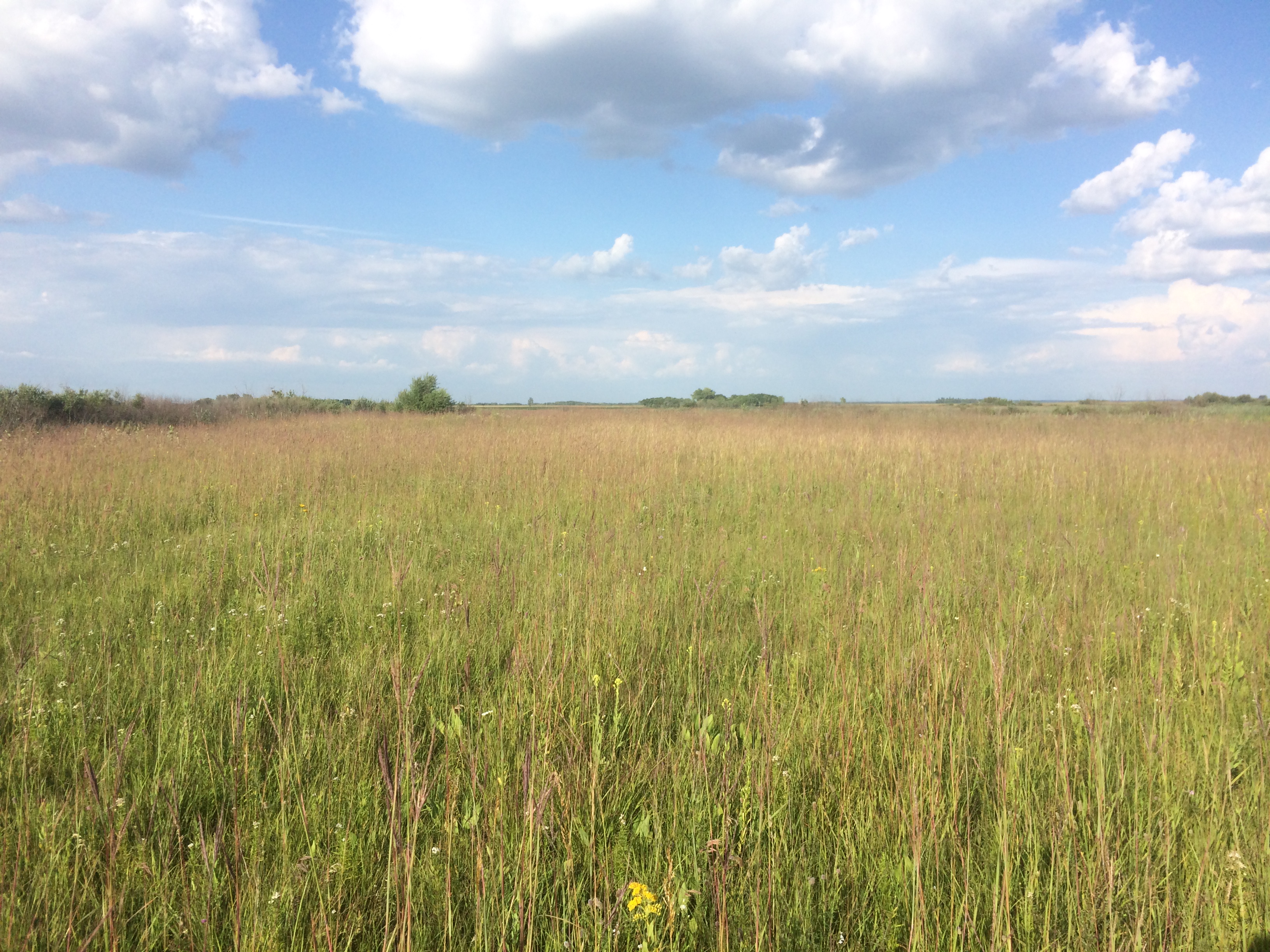
When I decided to become a volunteer for the SNA program, I looked to serve as a site steward for an SNA near my home. I imagined having responsibility for a rare woodland habitat or a bog. But the nearest SNAs that did not have stewards assigned were out in the Red River Valley, at least an hour from my home. These were remnants of the tallgrass prairie that somehow avoided the plow over the past 140 years.  What little knowledge of prairies I had came from books – I had never visited one before. I decided it was time to do some on-the-ground learning and signed up as a steward for Santee Prairie SNA, located near Mahnomen.

Santee Prairie is a 440-acre parcel originally purchased by The Nature Conservancy, an organization that specializes in acquiring neglected parcels of habitat. Santee includes upland prairie, cattail marshes and patches of shrubs and small trees. Attempts were made to drain and farm the land years ago; old ditches criss-cross the site. The SNA adjoins a state wildlife management area providing habitat for deer and small game, raptors, waterfowl and songbirds. Large areas of the SNA are wet much of the year, supporting not only cattail marshes but lush meadows. Upwelling groundwater at Santee creates conditions favorable to certain rare plants.

Spending time at Santee was intimidating at first. Being used to the woods, standing out there on the wide, flat land I felt vulnerable. Other than some scrubby aspen stands, there was no place to shelter. I grew up hating the wind that never seemed to quit blowing out on the farm and at Santee I was exposed again to its force. I did the perfunctory checks on the access points and signs, but did not spend much time exploring.

I was also intimidated by my lack of knowledge of the native plants I found there. I had taken every botany and plant ecology course I could in college, but that was over 30 years ago. I never really got to use or expand that knowledge during my desk-bound career. On top of that, what little I did know about grasslands pertained to places like Montana and Idaho. I had to brush up on my plant identification skills to begin identifying the myriad wildflowers I encountered.

IMG_1965During my first few trips out (we are asked by the DNR to visit once a month, if possible) I was mystified by the lack of grass. The ground was densely covered with forbs (leafy plants) and woody species like like willow and aspen. Grass seemed to be only a minor component of the plant community, which went against my idea of what prairie should look like. Finally, when I visited in August I encountered the “sea of grass” I had imagined. Big bluestem and Indian grass stood shoulder-high, towering over the other plants. These are called “warm season” grasses, which don’t even begin growing until July. I realized I had been looking in May and June for the “cool season” grasses I was used to seeing in drier grasslands out west.
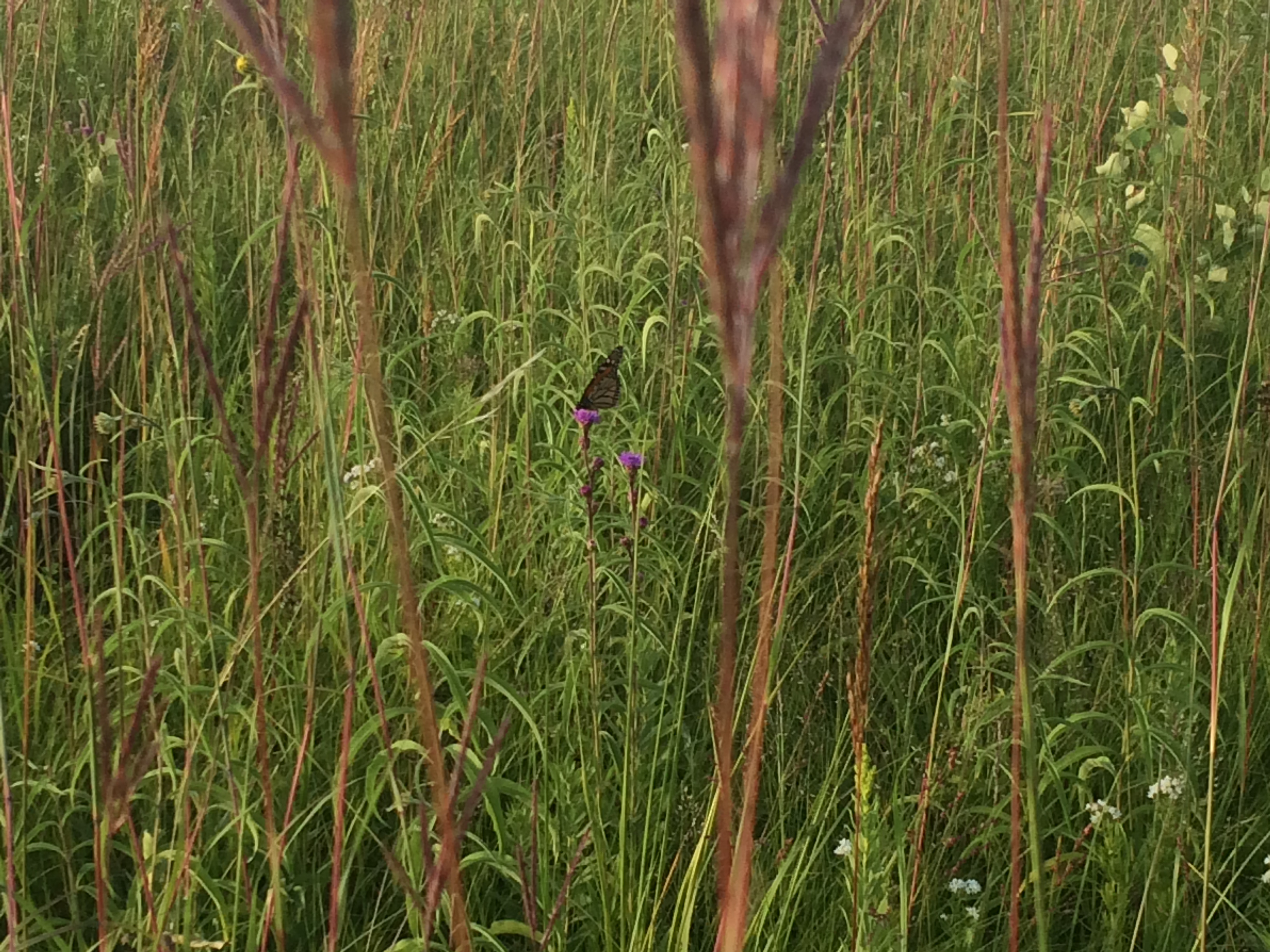
Wandering through the tall grass, I can experience what this place looked and felt and sounded like some 140 years ago when my ancestors came to homestead. I can get a sense of the wild land that greeted them and challenged them to make their home here. My great-great grandparents (see the Minnesota History page on this blog) relocated here when the White Earth reservation was established, homesteading about 30 miles south of Santee. They tucked their home into a stand of oaks above the Buffalo River, with a view of the tallgrass prairie stretching to the western horizon.

IMG_2060

I learn something every time I visit Santee and look forward to my next visit. On my last couple visits I spent hours wandering the prairie, identifying plants I had never seen before, spotting sandhill cranes, hawks and owls. I find myself staying almost until sunset, when I run out of daylight to see and explore. I am not only learning about the prairie, I am learning about myself. I realize I can experience that sense of wonder I felt as a kid in the woods now out on this open and windblown, wild place.


Waiting

This seems like the longest spring I can remember. Winter fizzled out this year, with little snow or cold weather beyond January. February kept us in a holding pattern. Winter seemed over, but we knew spring was a ways off. We began to warm up a bit in March and snow was mostly gone by mid-month.

During this time, I found myself looking for signs of spring, even though the calendar said it was still winter. All Minnesotans long for spring at some point. Even the most hardy winter lovers are ready to move on by March. But waiting for spring in this country can test anyone’s patience.

We’ve had some warm spells that have given us a foretaste of glorious summer. This year the ice was off the lake by April 4th, almost as early as last year, when spring came charging in full force in March. But this year spring advances and retreats like the last glaciers of the Ice Age. We’ve had temps in the 60s followed by temps in the 30s with snow.

On the lake, evidence of spring was proclaimed by the cacophony of waterfowl and shore birds from mid-March until ice out. We are blessed to have the outlet of our lake on the Crow Wing chain as our front yard. A small bay where the river reappears at the end of the lake stays open throughout the winter and is home to about 8 or 10 trumpet swans. As the the weather warmed and the open water increased in size, the swans were joined by Canada geese, then ducks including mallards, bluebills (scaup), goldeneyes and others. Then came mergansers and sandhill cranes (heard but yet to be seen). The loons and great blue herons arrived just before ice-out. A couple of juvenile bald eagles, probably raised in the nest between 5th and 6th Crow Wing, have been roosting in the white pines behind our house, eyeing the ducks and thinking about their first fishing forays.

In the much quieter woods, evidence of spring is slow to appear. Last week, my granddaughter and I inspected the hepatica, just beginning to bloom. A few mayflowers and violets are appearing this week. The red maples I planted last year flowered at Easter, as did the leatherwood. Other trees and shrubs have broken bud but have yet to unfurl their first leaves. Slowly, slowly is the spring unfolding.

I’ve learned to appreciate the waiting. When I was a kid, I looked forward to spring only as a precursor to the fishing opener and the warm-up to summer. Spring was just a season of mud and restless anticipation. And summers were always too short. Then back to school and more waiting, for hunting season, first snow, ice for fishing, for Christmas break.

Often I sense that time is accelerating as I get older. The weeks and months fly by and before you know it your first little grandchild is 12 years old and taller than her grandma.  Now this long, slow spring feels like a gift of time. There was time get in some woodcutting before the ground thaws. There is time to rake up last fall’s leaves and the winter detritus before the grass takes off. There is time to observe the each week’s arriving migrants among the songbirds. And there is time to walk in the woods with my youngest granddaughter to look for new wildflowers, to experience her wonder and joy. So let spring take its sweet time in coming, for the time is sweet.

Virus

Although I still have a few sniffles, I appear to be over my bout with the flu. Over the past few days, sitting in my jammies binge-watching Cosmos, I began to ponder viruses. In short, they are amazing. According to Wikipedia (I’m too sick to go the library), a virus consists of a chunk of genetic material (DNA or RNA) coated with proteins for protection. That’s it.

Remember drawing cells with a nucleus and mitochondria in biology class? We learn cells are the basic building blocks of life. Life begins in a cell. Even single cell organisms (think of looking at Paramecium under a microscope back in Biology 101) are obviously alive, busy swimming around finding food. They have everything they need in their cell to replicate themselves, to carry on life.

Viruses are not “alive” because they are not a cell – they are lumps of organic material. They do come in interesting shapes and some even have “heads” and “tails”. But basically we are just talking about a chunk of genetic material lying about. Flotsam seemingly left over from the process of evolution. They are everywhere, “found in almost every ecosystem on Earth and the most abundant type of biological entity” (Wikipedia).

Viruses are not alive, but boy can they replicate. That’s where we come in. Viruses need to infect living organisms to propagate themselves. They sneak into our cells and hijack the equipment. Then, like the pep club commandeering the principal’s photocopier, they make a bunch of copies of themselves. After they have used up all the paper and toner, the viruses are ready to be spread to more hosts.

Once again, we lend a helping hand (especially if we don’t wash our hands). Viruses need us to spread them around. Because they are tiny, they travel through the air, propelled by a good sneeze or cough. This may seem like a random process, a biological accident. But viruses have evolved to become more effective at replicating and spreading.

Think about that. How does something that is not alive evolve? Another thing we learn in Biology 101 is that all living things seek to reproduce, to ensure their species survives. That’s called the biological imperative. Animals eat, sleep, hunt or gather, play, have sex. Even plants have sex with the help of pollinators. Viruses do none of these things. Yet they persist, mutating to find better ways to survive.

I am sure there are evolutionary biologists who could explain it all. But they would miss the point. The point is, viruses are amazing. Life is amazing.

After the Election

I’ve been spending the morning trying to process what happened on Election Day. I tend to vote blue, but I wasn’t crazy about Hillary Clinton. I was appalled by Donald Trump. Now I realize it was not about Trump. It’s about people wanting change in Washington. It didn’t matter to them what Trump did or said; it was a protest vote.

President Obama and the Democrats ignored the people left out of their coalition, especially rural white folks. A lot of people have been left behind in the ongoing economic recovery. Neither party has done much to help them, but the party holding the White House got most of the blame. Trump successfully tapped into their anger and manipulated it to win.

Trump has handed the Republicans a huge victory, in spite of the reluctance of their leaders to support him. They have an opportunity to get things done, to help the country the way they think best. But they don’t know what they have in their leader. What does he really stand for? What does he really want for our country? What does he want from Republicans in exchange for cooperating with them?

The most promising aspect of yesterday’s outcome is the fact that the process worked. The election was not rigged. The people have spoken and made their choice. They will do so again in four years. Who will be angry then and at whom? Who will be left behind in the next four years?

How do we solve the divisiveness so evident in this election? We can start by resisting the urge to lump together those opposed to us as bigots, racists, uneducated, “deplorables”. The reality is many Trump supporters are decent, hard working people, who want something better. Just like we who did not support Trump do. We have to remember that there is no “us and them”. There is only us. We know this because we participate together in the electoral process and together we accept the outcome. That is what unites us: we believe in democracy.

We have to trust that our electoral process, as ugly as it is, however uglier it can possibly get, will work again in four years. This is what I told my millennial kids, both of whom called this morning distraught and scared. We have to trust in our democratic process and use it. Use it or lose it.